
Review · VIENNA
Vienna: Hop-On Hop-Off Sightseeing Bus Tour in 19 Languages
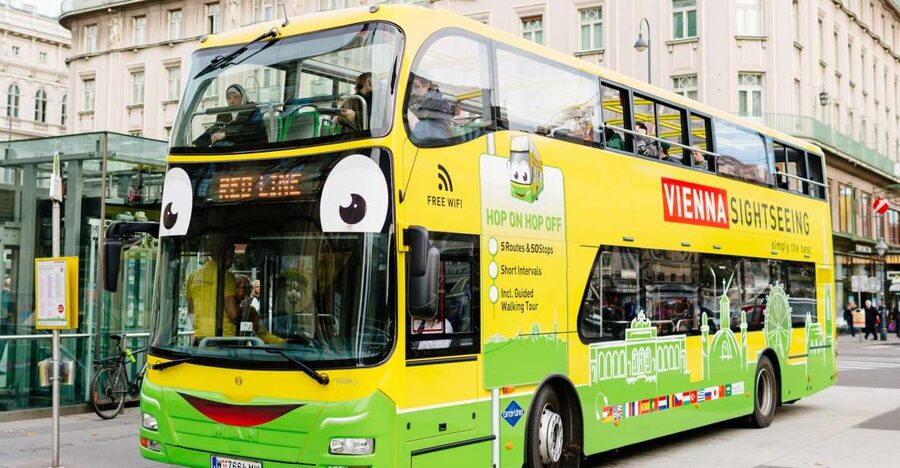
Vienna’s hop-on hop-off bus is most useful as a first-day orientation tool. You can circle the grand Ring Road, reach Schönbrunn and Belvedere without sorting out several tram connections, then mark the places you want to revisit on foot. The network covers four distinct parts of the city, not just the usual central loop.
I like the clear route choices and the frequent buses, especially on the Red, Blue, and Yellow lines. I also like the practical extras: 19-language audio, free Wi-Fi, GPS tracking, and a walking tour app. The main drawback is time. A 24-hour ticket can feel rushed if you try to ride every route and still visit museums or palaces.
Key points to know before you book
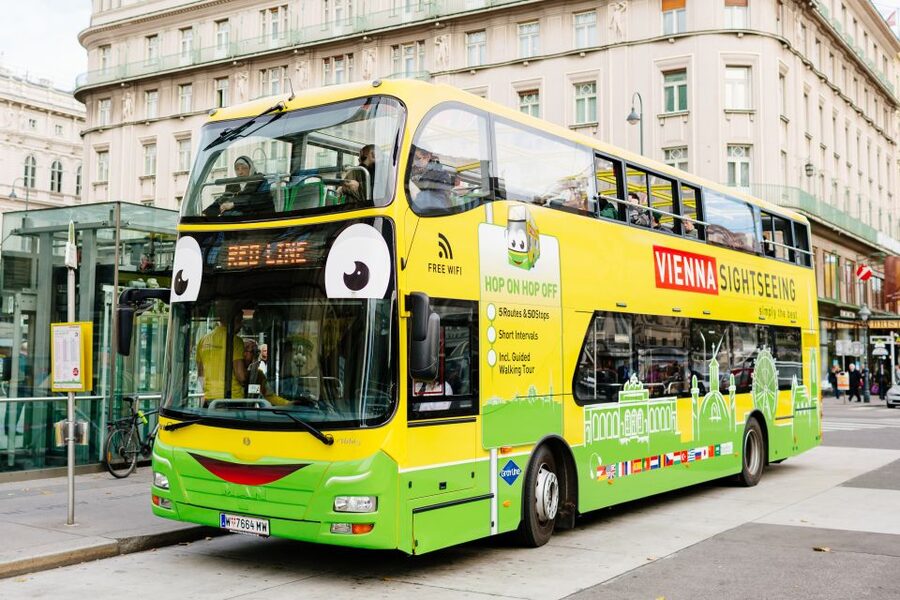
- Four routes cover very different sides of Vienna: the Red Line circles the Ring Road, the Yellow Line reaches Schönbrunn and Belvedere, the Blue Line runs out toward the Prater and Danube, and the Green Line heads to Grinzing and Cobenzl in summer.
- The State Opera is the main transfer point: several lines meet here, making it the easiest place to change buses.
- Schönbrunn is about 35 minutes from the Opera: allow extra time if you plan to tour the palace rather than simply see it from the bus.
- The Green Line is seasonal: it is included with 24, 48, and 72-hour tickets when it operates, but buses run only about once an hour.
- The audio guide is useful for first visits: commentary is offered in 19 languages, with German and English children’s channels.
- A 48 or 72-hour ticket gives you breathing room: you can use one day for orientation and another for stops such as Schönbrunn, Belvedere, or the Beethoven Museum.
Why this bus works well for a first look at Vienna
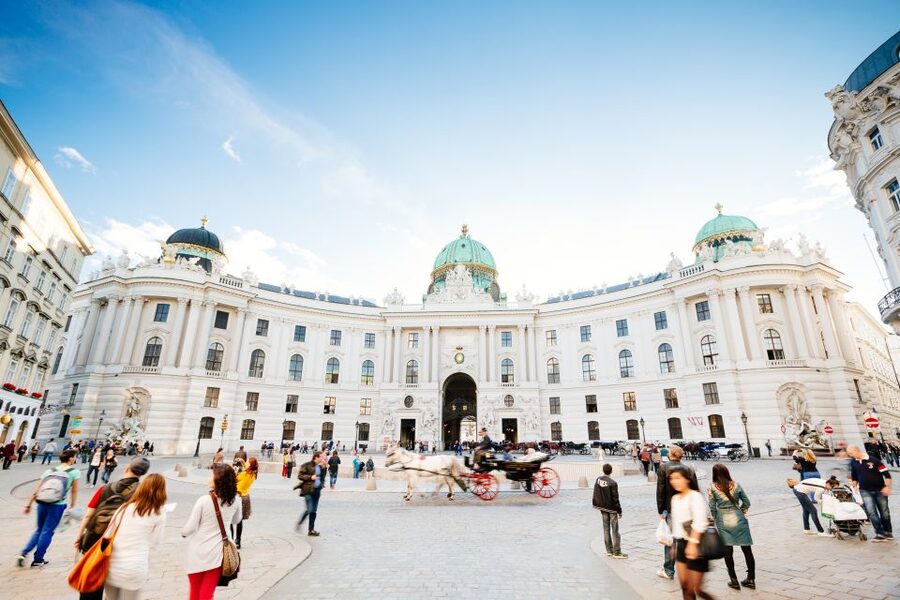
Vienna is easy to explore by public transport, but its sights are spread across several districts. The Hofburg and museums sit in the center, Schönbrunn is well to the west, Belvedere is south of the center, and the Prater and Danube lie to the east.
This bus links those areas in a way that is simple to understand. You show your voucher to staff beside the yellow Vienna Sightseeing Tours buses, receive your ticket, and then board at any stop on the four lines. You do not need to begin at a fixed departure point.
I find the format especially helpful after arriving by train. The Yellow Line serves Vienna Central Station, and several routes connect near the State Opera. One practical detail: Westbahnhof service can change by season, so check the current stop arrangement rather than assuming every line runs there all year.
The buses arrive every 20 to 30 minutes on the main routes, depending on the line. That is frequent enough for short stops, but not so frequent that I would plan a five-minute visit to a major palace. Keep the route map and bus times handy, especially late in the day.
More Hop-On Hop-Off Bus Tours in the world:
- Barcelona: 24 or 48-Hour Hop-On Hop-Off Bus Tour
★ 4.4 · 20,872 reviews - Rome: City Sightseeing Hop-on Hop-off Bus with Audioguide
★ 4.0 · 16,045 reviews - Paris: Tootbus Hop-on Hop-off (Optional River Cruise)
★ 4.3 · 15,279 reviews
Red Line: Vienna’s grand Ring Road in 60 minutes
The Red Line is the best starting point if you want to understand central Vienna. Its one-hour circuit follows much of the Ring Road, the grand boulevard lined with imperial and civic buildings.
The route begins at the State Opera, a useful central landmark and a major transfer point. From there, the bus passes the Museum of Art History and Heroes’ Square, where the Hofburg complex gives you a quick sense of Vienna’s former imperial center.
The stop at Mariahilfer Straße is useful for shoppers and for anyone staying near the western side of central Vienna. The route then continues past the Burgtheater and City Hall, followed by the University and the Liebenberg Monument.
The Sigmund Freud Museum stop gives you a way to combine the bus with a more personal look at Vienna’s intellectual life. The Votive Church is another worthwhile central stop, particularly if you like grand nineteenth-century architecture.
The Red Line then runs by Vienna Airport Lines, DDSG City Cruises, the Museum of Applied Arts, the City Park, and the Strauss Monument before returning to the Opera. The audio commentary helps connect the buildings as you pass, and each stop is clearly announced.
Buses run about every 30 minutes from roughly 9:30 a.m. to 5:30 p.m. The main limitation is that the Red Line is better for orientation than for reaching far-flung sights. I would ride it once without getting off, then return to the Hofburg, museums, or City Park on foot.
Yellow Line: Schönbrunn and Belvedere without the transport puzzle

The Yellow Line is the route that makes the ticket most valuable for many first-time visitors. It connects the State Opera with Westbahnhof, Schönbrunn Palace, Vienna Central Station, the Museum of Contemporary Art, Belvedere Palace, and Lower Belvedere.
The ride from the Opera to Schönbrunn takes around 35 minutes. That is considerably easier than planning a separate trip from the center, especially if you want to see several sights in one day.
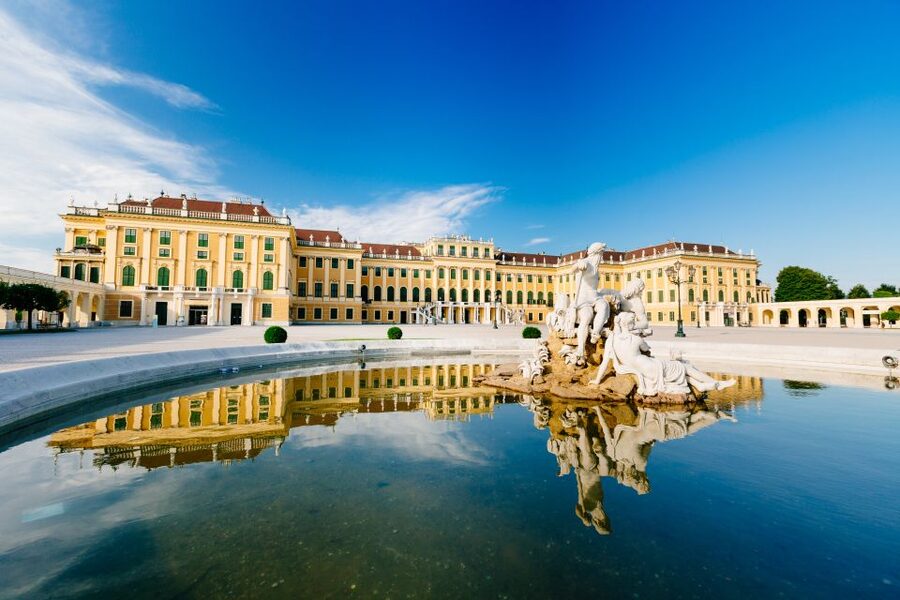
Schönbrunn deserves more than a quick photograph from the bus. If you want to visit the palace rooms or spend time in the gardens, get off and allow a proper block of time. The bus is your connection, not your palace admission. Entrance fees are not included.
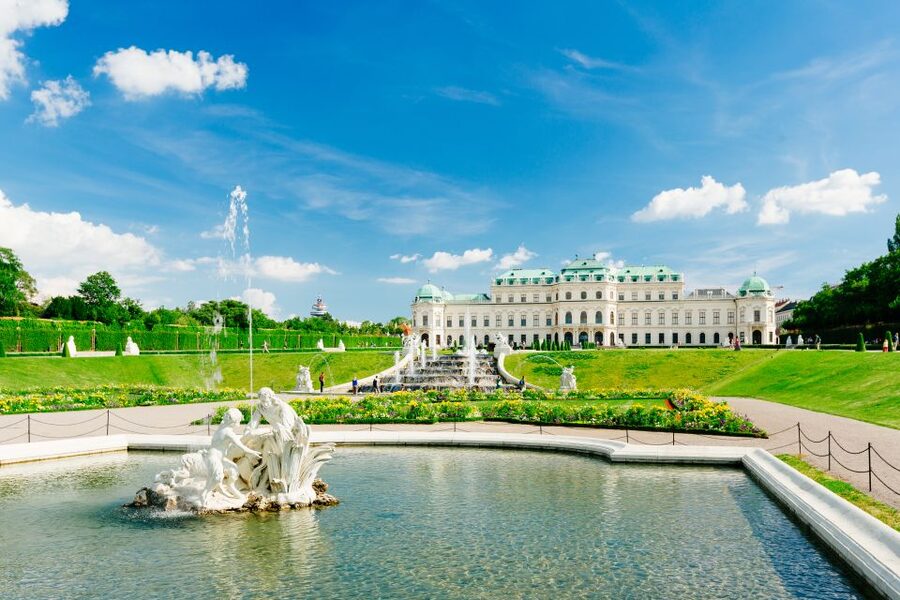
The line then returns toward the city and continues to Belvedere Palace and Lower Belvedere. These are separate stops, so check which building suits your plan. Belvedere is particularly convenient for combining palace grounds with an art visit, but again, admission costs extra.
Buses run every 20 to 25 minutes, generally from about 9:15 a.m. to 5:15 p.m. This route takes around 90 minutes for the full circuit. The practical catch is closing time. If you spend the afternoon inside Schönbrunn, do not assume a late bus will still be waiting.
Blue Line: the long ride to the Prater and Danube
The Blue Line is the broadest route, taking about two hours for the full circuit. It combines many central stops with Vienna’s eastern sights, so it works best when you have time to spare.
In the center, it shares useful stops with the Red Line, including the Museum of Art History, Heroes’ Square, Mariahilfer Straße, City Hall, the University, the Sigmund Freud Museum, Votive Church, City Park, and the Strauss Monument. That makes it easy to switch from a central sightseeing loop to the eastern side of the city.
The route then reaches the KunstHausWien, the Hundertwasser Museum, and the Giant Ferris Wheel in the Prater area. The Prater is one of Vienna’s most recognizable recreational areas, and the Ferris wheel is a natural place to leave the bus if you want a closer look.
Farther east, the Blue Line reaches the Imperial Bridge, Danube Tower, Old Danube, UNO City, Danube Island, Praterstern, Taborstraße, and the Museum of Crime. These stops show a less imperial side of Vienna, with modern districts, river areas, and major public buildings.
Buses run approximately every 20 minutes from around 9:30 a.m. to 5 p.m. That frequency is helpful, but the two-hour circuit means you should not ride the entire route casually if you also plan palace visits. I would use the Blue Line for one chosen area, such as the Prater and Danube, instead of trying to combine it with every central museum.
More Sightseeing Bus Tours in the world:
- Barcelona: City Sightseeing Hop-On Hop-Off Bus Tour
★ 4.4 · 10,061 reviews - Rome: Big Bus Hop-on, Hop-off Open-Top Sightseeing Tour
★ 4.1 · 9,537 reviews - City Sightseeing London Hop-On Hop-Off Bus & Bookable Extras
★ 4.4 · 7,374 reviews - Hamburg: Line A Sightseeing Hop-On Hop-Off Bus Tour
★ 4.6 · 6,958 reviews
Green Line: a summer outing to Grinzing and Cobenzl
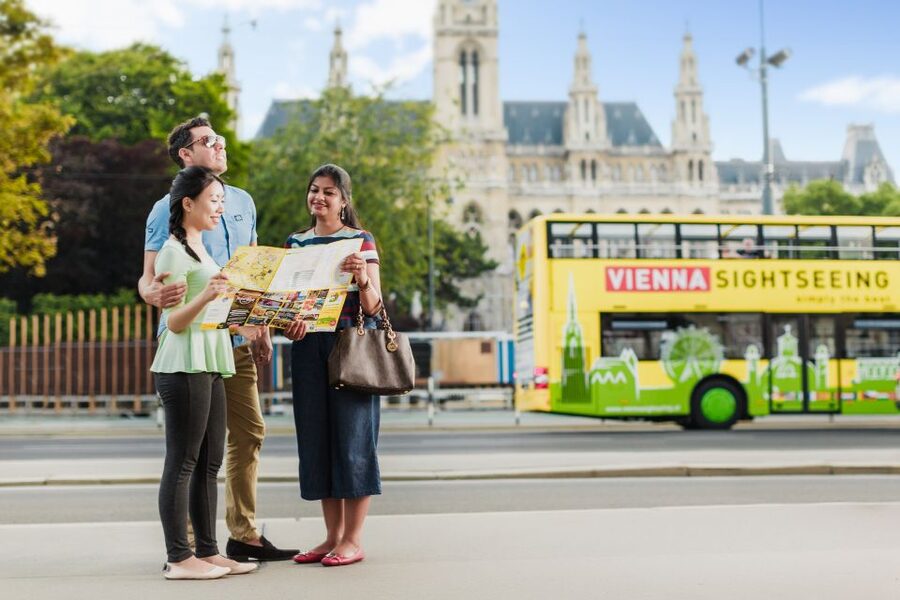
The Green Line is the scenic extra. It travels toward Grinzing and Cobenzl, where you can get broad views over Vienna from higher ground.
This route operates only in the summer months. It is included with 24, 48, and 72-hour tickets when available, but the buses run about once every 60 minutes, from roughly 10:45 a.m. to 4 p.m.
That hourly service changes how you should plan the day. Check the departure time before getting off, since missing a bus can cost you a long wait. The Green Line is best treated as a half-day outing, not as a quick add-on between museum visits.
I like that it gives the ticket a different purpose. The Red, Yellow, and Blue routes focus on famous buildings and transport links. The Green Line gives you fresh air and a view over the city. If the timetable does not fit, use public transport for the return instead of losing the rest of your afternoon.
Audio, Wi-Fi, and the walking tour app
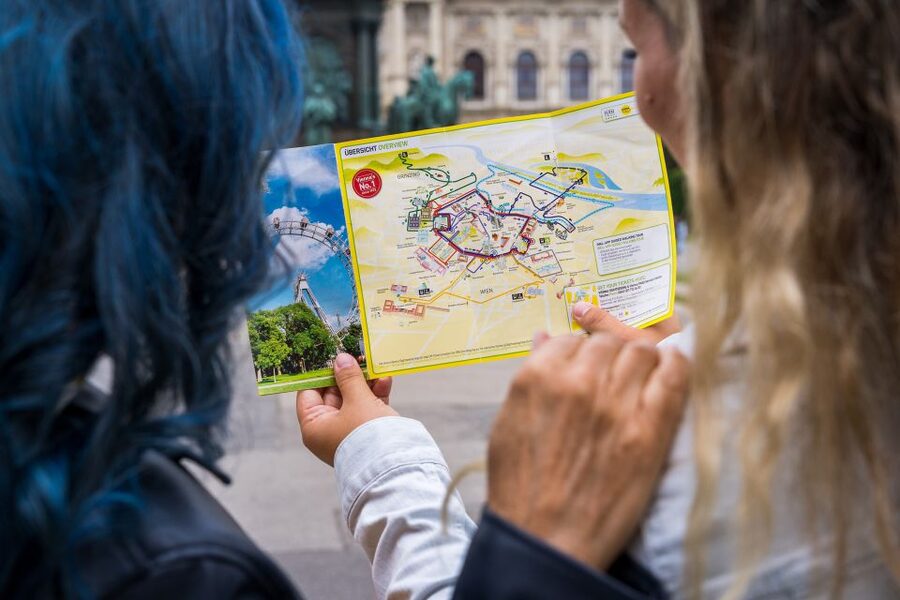
The audio commentary is available in 19 languages: German, English, Italian, French, Spanish, Portuguese, Dutch, Romanian, Czech, Hungarian, Turkish, Greek, Russian, Japanese, Chinese, Serbian, Korean, Polish, and Arabic.
The commentary is most useful on the Red Line, where the buildings pass one after another and a short explanation helps you understand what you are seeing. It also gives children a German or English channel. Stop announcements are clear, which matters when you are watching several buildings at once.
The information supplied for the activity lists both 19-language commentary and an older 16-language inclusion line. The current language list includes all 19, including Polish, Korean, and Serbian, so confirm the available channel when you board if a particular language matters to you.
Free Wi-Fi is available on the buses. GPS live tracking through the website is another practical aid, especially when you are deciding if it is worth walking to the next stop or waiting for the bus.
Your ticket also includes a self-guided walking tour through the QuietVox app. You collect headphones and a map from the local partner’s service center, then follow the route through central Vienna. The walk includes the State Opera, Beethoven Statue, Vienna Concert House, House of Music, and Beethoven Museum.
This walking option solves one weakness of bus sightseeing: Vienna’s streets are best appreciated at ground level. I would use the bus to connect districts, then use the walking tour for the central details.
How much time should you allow?
A 24-hour ticket costs about $41 per person. That is a fair price if you use it for several substantial journeys, such as central Vienna in the morning, Schönbrunn in the afternoon, and Belvedere or the Prater later.
It is less attractive if you stay on for one short circuit and never get off. The ticket is transport plus commentary, not admission to the palaces, museums, or Ferris wheel. Budget separately for every attraction you enter.
The 24-hour period is measured from activation, so starting at 10:30 a.m. can let you use the ticket into the following morning, within the operating timetable. Still, early closing times limit the real benefit.
A 48-hour ticket gives you time to split the city into manageable sections. A 72-hour ticket is the best choice if you want one route per day, or if you plan longer visits at Schönbrunn, Belvedere, museums, and the Prater.
For a short city break, I would choose 48 hours if the price difference is reasonable. You can ride the Red Line first, spend another day on the Yellow and Blue lines, and avoid turning every stop into a rushed photo break.
What the buses are like in practice
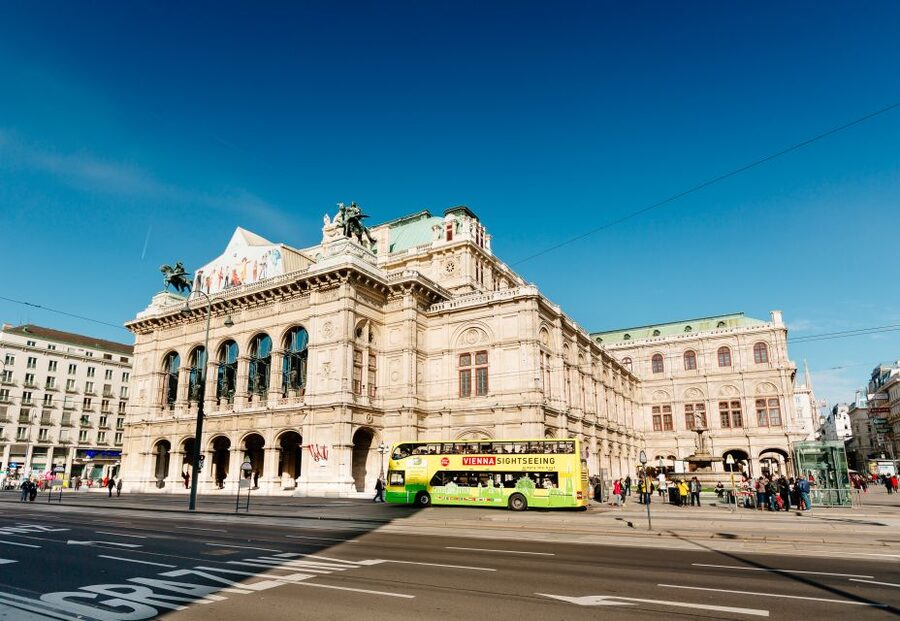
The buses are described as clean and comfortable, with windows that can be adjusted for changing weather. That matters in Vienna, where an open-top ride is pleasant in sunshine but less appealing in wind or rain.
Staff are generally easy to find near the Opera and other stops, with signs identifying the service. Drivers and route staff can help with direction, though the experience is primarily an audio-guided city tour rather than a live guide on every bus.
Karen is specifically identified as a guide who made one tour especially interesting. Do not book this expecting Karen or another named guide to be guaranteed, since the service uses several buses and routes.
A few practical complaints are worth taking seriously. Some stops can feel long if you are trying to cover the city quickly. The Green Line’s hourly frequency is the clearest example. Also, the buses generally finish by late afternoon, so this is not an evening sightseeing option.
Smoking is not allowed, and pets are not permitted except assistance dogs.
Who will get the most from this tour?
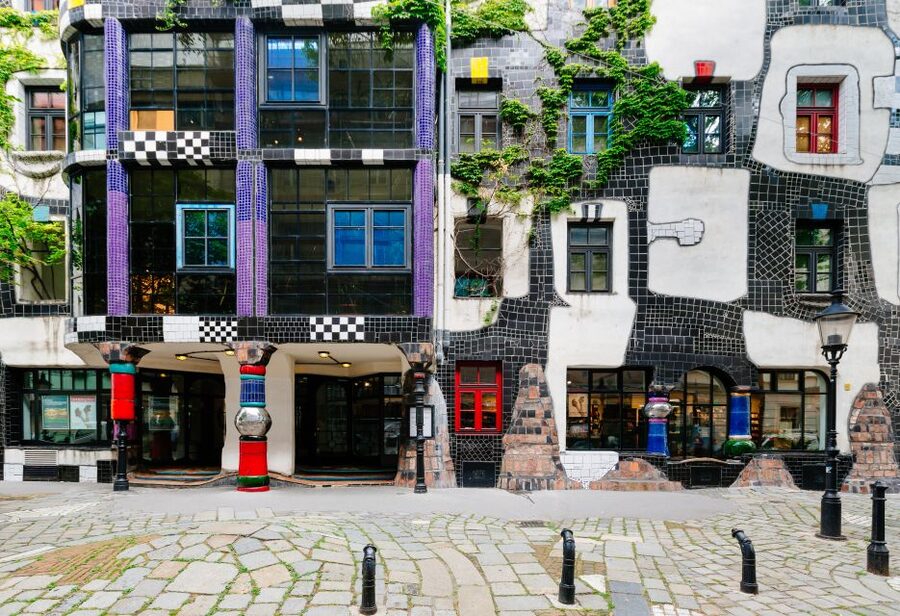
I would recommend it to first-time visitors, families, older passengers, solo visitors who want an easy overview, and anyone making a short stop in Vienna. It is also useful if you want to identify museums and neighborhoods before committing to a full day on foot.
It suits you less if you already know Vienna well, prefer local trams, or want a slow and detailed look at each district. A city bus cannot replace walking through the Hofburg, sitting in a café, or spending hours inside Schönbrunn.
The strongest plan is simple:
- Ride the Red Line early to get your bearings.
- Use the Yellow Line for Schönbrunn and Belvedere.
- Choose one eastern section on the Blue Line, such as the Prater and Danube.
- Add the Green Line only when its summer timetable fits.
- Use the walking app for central Vienna at ground level.
Should you book the Vienna hop-on hop-off bus?
Book it if you want broad coverage with little planning. The four routes reach the main sights, the audio is offered in 19 languages, and the bus links places that are awkward to combine on foot.
Choose 48 or 72 hours if you want to enter museums and palaces rather than only photograph them. Choose 24 hours for a quick overview, but accept that you will need to be selective.
I would not use this as your only way to experience Vienna. Use it as a practical framework, then get off, walk, and spend time inside the places that catch your attention. That combination gives you the convenience of the bus without missing the city at street level.
FAQ
How long are the ticket options?
You can choose a 24-hour, 48-hour, or 72-hour ticket.
How many bus routes are included?
The ticket provides access to up to four routes: Red, Yellow, Blue, and Green. The Green Line operates only during the summer months.
What languages are available for the audio guide?
Audio commentary is available in German, English, Italian, French, Spanish, Portuguese, Dutch, Romanian, Czech, Hungarian, Turkish, Greek, Russian, Japanese, Chinese, Serbian, Korean, Polish, and Arabic.
Is there commentary for children?
Yes. A children’s commentary channel is available in German and English.
Does the ticket include palace and museum admission?
No. Entrance fees to sights and attractions are not included.
Where can I board the bus?
You can board at any stop on the Red, Yellow, Green, or Blue routes. Look for the yellow buses and Vienna Sightseeing Tours signage, then show your voucher to a representative to receive your ticket.
Is Wi-Fi available on the buses?
Yes. Free Wi-Fi is available on all buses. GPS live tracking is also available through the website.
Just joined the route map around the world
- San Pedro de Atacama: Vallecito + Magic Bus★ 5.0 · 4 reviews
- Santander: City Sightseeing Hop-On Hop-Off Bus Tour & Train★ 4.3 · 170 reviews
- Santiago: 1-Day Hop-On Hop-Off Bus and Cable Car Ticket★ 4.3 · 332 reviews
- San Fransisco: Vintage VW Bus Wine Country Tour Small Group★ 5.0 · 5 reviews
- San Francisco: Sightseeing Sunset Tour by Open-Top Bus★ 4.4 · 105 reviews
- San Francisco: Movie Filming Locations Bus Tour★ 4.9 · 368 reviews
- SF: Napa & Sonoma Wine Tour & Hop-on Hop-off Tour (Save 15%)★ 4.5 · 2 reviews
- San Francisco: Hop-On Hop-Off Tour with Optional Night Tour★ 4.5 · 94 reviews
Vienna Bus Tours, side by side.
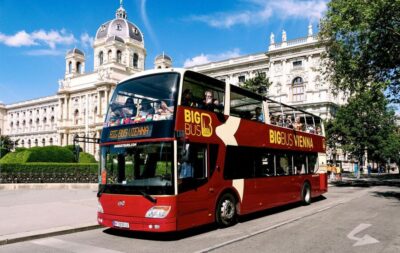
Vienna: Big Bus Hop-On, Hop-Off Tour by Open-Top Bus
Read our review →
Vienna: Bus & Schönbrunn Palace Skip-the-Line Guided Tour
Read our review →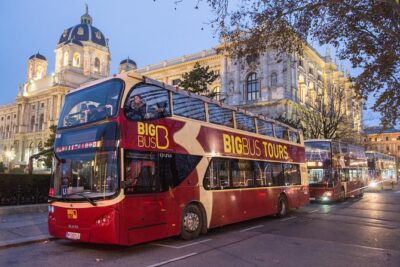
Big Bus Vienna Hop-On Hop-Off Sightseeing Tour
Read our review →
From Vienna: Guided Tour to Bratislava with Speed Boat Ride
Read our review →
From Vienna: Roundtrip Bus to Bratislava with Walking Tour
Read our review →Other lists with this bus tour