

Review · BARCELONA
Barcelona: City Sightseeing Hop-On Hop-Off Bus Tour
Barcelona’s most useful sightseeing tool may be a bus ticket. This open-top double-decker covers the city’s spread-out sights on two routes with 38 stops, letting you see Gaudi’s masterpieces, Montjuic, the waterfront, Camp Nou, and Park Guell without stitching together a day of metro rides and uphill walks.
I like the easy orientation and the freedom to choose your own pace. I also like that one ticket works on both the Red and Blue routes, a detail worth knowing before you board. The main catch is time: the full circuit takes about 120 minutes, buses stop at 7pm, and popular stops can be crowded.
Quick take: what makes this bus useful

- Two routes reach very different parts of Barcelona: The Red Line covers Montjuic, the port, beaches, Poblenou, and Sagrada Familia, while the Blue Line heads toward Park Guell, Pedralbes, and Camp Nou.
- You can use both routes on one ticket: This makes the 48-hour option especially practical if you want to stop often.
- The open upper deck gives you a broad city view: It is excellent for orientation, though the sun can be intense in summer and the air can feel cold in winter.
- The audio guide comes in 16 languages: Commentary is available in Spanish, Catalan, Chinese, English, French, German, Italian, Japanese, Portuguese, Russian, Dutch, Hebrew, Swedish, Arabic, Turkish, and Norwegian.
- Park Guell requires a serious uphill walk from its stop: Plan for this if walking is difficult or if you are traveling with young children.
- The buses are sightseeing vehicles, not a late-night transit service: The last departure from Stop 1 is at 7pm on both routes.
Why start with the bus on your first day

Barcelona is not a compact old town with a few sights gathered around one square. Its treasures spread from the medieval lanes of the Gothic Quarter to the beaches, from Montjuic in the southwest to Park Guell and Tibidabo in the northwest.
That makes this tour most useful at the beginning of your stay. I would use it to learn the city’s shape, mark the places I want to return to, and save my feet for the neighborhoods themselves. You can ride one full circuit, listen to the commentary, and then decide where to get off.
A 24-hour ticket costs about $39 per person. That is not the cheapest way to move around Barcelona, since the metro can cost less for simple point-to-point trips. But the bus includes sightseeing, recorded explanations, a map, and the ability to hop off at major attractions. If you make several stops, the price becomes easier to justify.
The 48-hour ticket is the better choice for a relaxed schedule. It is valid on consecutive days, so you cannot spread the two days across separate parts of your trip. Still, two days give you time to explore without treating every stop like a race.
More Hop-On Hop-Off Bus Tours in Spain
- Barcelona: 24 or 48-Hour Hop-On Hop-Off Bus Tour
★ 4.4 · 20,872 reviews - City Sightseeing Barcelona Hop-On Hop-Off Bus Tour: 24 or 48-Hour
★ 4.0 · 5,250 reviews - Seville: City Sightseeing Hop-On Hop-Off Bus Tour
★ 4.0 · 4,633 reviews
The Red Route: Gaudi, Montjuic, the port, and the coast
The Red Line is the route I would choose if you want the widest mix of Barcelona. It begins at Plaça de Catalunya, the city’s central meeting point, and passes through the elegant Eixample district before heading south and east.
At Casa Batllo and Fundació Antoni Tapies, you are in the heart of modernist Barcelona. Casa Batllo is one of Antoni Gaudi’s most playful buildings, with a facade that rewards a close look. The bus gives you a useful first glimpse, but you will need to get off and buy an entry ticket if you want to see inside.
The Eixample stop introduces the broad, ordered streets that contrast with the Gothic Quarter’s narrow lanes. Continue toward Sants and Plaça d’Espanya, a major transport and civic area. This is a practical stop for reaching Montjuic and several museums.
The next stretch includes CaixaForum and the Mies van der Rohe Pavilion, followed by Poble Espanyol. These are separate attractions, so attraction tickets are not included. Poble Espanyol is a constructed Spanish village with architecture, shops, and places to eat, while the pavilion offers a quieter architectural visit.
The route then climbs around the Montjuic area, passing the Museu Nacional d’Art de Catalunya, the Olympic Ring, the Joan Miro Foundation, the Montjuic cable car, and Miramar with the Costa i Llobera gardens. This is one of the strongest sections for views. You see how Barcelona rises from the port toward the hills, and you can choose among museums, gardens, Olympic sites, and cable-car rides.
Give Montjuic time. You cannot reasonably visit every stop and still complete the rest of the route in one afternoon. If you have only one day, pick one or two places rather than trying to collect them all.
From Montjuic, the bus descends to the World Trade Center and the Columbus monument at the lower end of La Rambla. The La Rambla stop is useful for entering the central old city, but keep your map close and watch your belongings in crowded areas.
The Red Line also stops near the Museum of the History of Catalonia and Port Olimpic before following the coast. Platja del Bogatell and Platja Nova Mar Bella show a more modern seaside side of Barcelona, away from the old center. The Forum, Diagonal Mar, and Poblenou take you through newer districts with wide streets, apartments, restaurants, and beach access.
Torre Glories is a good landmark for understanding the newer city. The route then reaches Sagrada Familia, usually one of the busiest stops. You get a particularly useful view from the bus, and there is a stop behind the basilica that works well for photographs.
Sagrada Familia is not just another church stop. Gaudi’s unfinished basilica is the city’s defining sight, and its towers and sculpted facades need time on foot. The bus ticket does not include admission, so reserve a separate entry if you plan to go inside. At busy times, you may not board the first bus leaving this stop.
The final Red Line stops include Arc de Triomf and return points near the center. The stop is close to the monument even if the bus does not place you directly in front of every sight. Keep an eye on the map, since some stops are labeled clearly but still leave you with a walk.
The Blue Route: Park Guell, Pedralbes, and Camp Nou
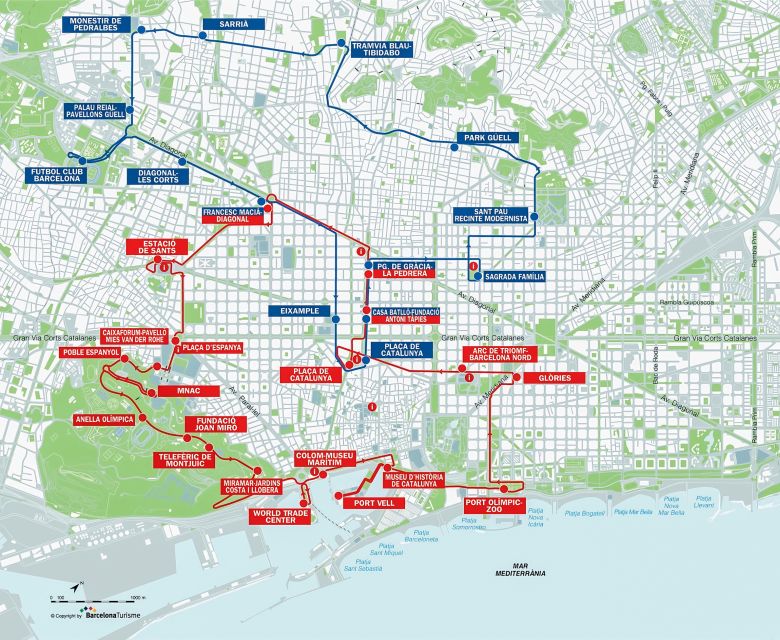
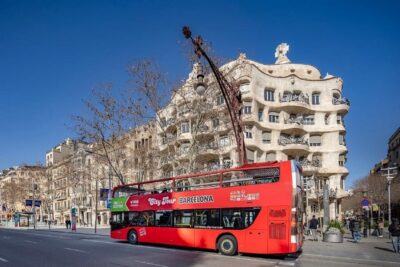
The Blue Line is shorter in feel but reaches several major attractions that the Red Line misses. It starts at Plaça de Catalunya, shares early stops near Casa Batllo and the Eixample, then continues along Passeig de Gracia toward La Pedrera.
La Pedrera, also called Casa Mila, is another Gaudi landmark. Its unusual stone facade and rooftop forms make it worth a stop, though again, admission is separate. Sant Pau Recinte Modernista follows, an impressive modernist complex that gives you a different view of the architectural movement than the better-known Gaudi houses.
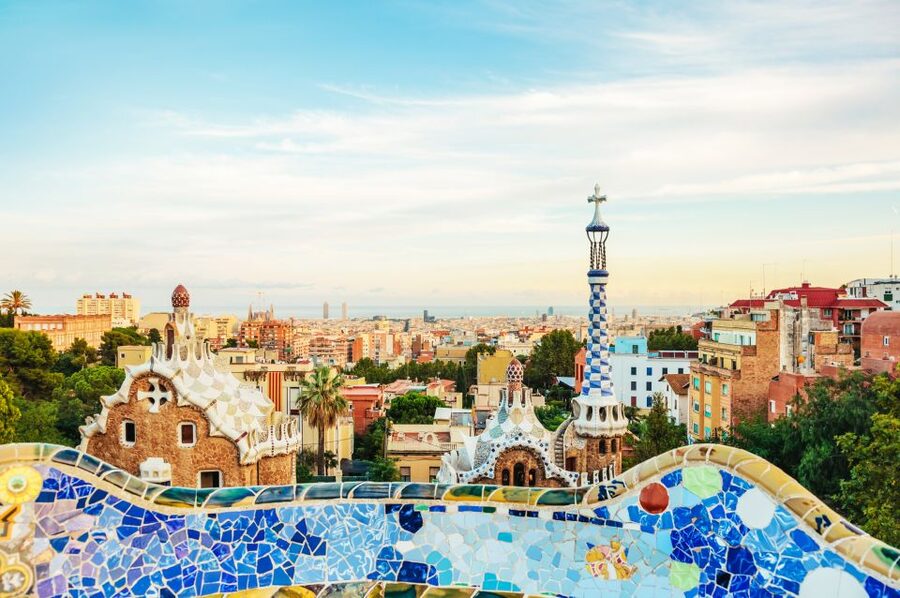
The route’s key destination is Park Guell. The bus stop does not place you at the park gate. You should expect a long, steep uphill walk, which can be tiring in hot weather and difficult for anyone with limited mobility. This is the clearest practical weakness in the route.
If you can manage the climb, Park Guell rewards you with Gaudi’s colorful tile work, unusual structures, and views across the city. Wear sensible shoes and leave enough time for both the walk and the park itself. The tour does not include the attraction ticket.
The bus continues to Tramvia Blau and Tibidabo, then Sarria and the Monastery of Pedralbes. These stops take you farther from the central tourist zone. They are useful if you want to see residential Barcelona, visit the monastery, or reach Tibidabo, but they make the full route longer.
Palau Reial and the Güell Pavilions lead toward FC Barcelona. Football fans should plan their hop-off here. The tour provides transport to the club area, but stadium or museum admission is not part of the bus ticket. If Camp Nou is a priority, check your separate booking time carefully because traffic and boarding delays can affect your schedule.
The Blue Line finishes through Diagonal, Les Corts, Francesc Macia, Eixample, and Sant Antoni. The route has fewer obvious sightseeing stops than the Red Line, but it connects important parts of the city and gives you access to Park Guell, the modernist sites, and the football club.
How to plan 24 or 48 hours
A full loop takes about two hours, before any traffic delays or stops. That sounds quick on paper, but Barcelona has busy roads and many points where you will want to get off.
For one day, I would avoid trying to visit every stop. One practical plan is the Blue Line in the morning, with time for Park Guell or Sant Pau, followed by the Red Line in the afternoon. Another is to ride the Red Line first and stop at Montjuic, the port, or Sagrada Familia.
Many people use the 24-hour ticket across two calendar days by starting in the afternoon. If you board at 2pm, the ticket remains valid for 24 hours, not just until midnight. That lets you ride one route on the first afternoon and another the next morning.
The 48-hour ticket makes more sense if you want real visits rather than quick photographs. Use one day for the Red Line and one for the Blue Line, with only a few carefully chosen stops on each. You can also use the bus as transport between neighborhoods, but allow extra time for the sightseeing circuit.
The first bus leaves Stop 1 at 9am, and the last leaves Stop 1 at 7pm. Do not assume the bus will carry you back to the starting point after 7pm. A late afternoon departure can leave you needing a taxi or another form of transport back to your hotel.
Buses are listed as running about every 20 minutes. Extra high-season service is advertised as frequently as every five minutes, but I would still allow a cushion at busy stops. Sagrada Familia can fill quickly, and you may need to wait for the next bus.
More Sightseeing Bus Tours in Spain
- Palma de Mallorca: City Sightseeing Hop-On Hop-Off Bus Tour
★ 4.1 · 4,450 reviews - Madrid Panoramic City Bus Tour
★ 3.5 · 3,118 reviews - Barcelona City Tour Hop-On Hop-Off with Optional Boat
★ 4.0 · 3,012 reviews - Malaga: City Sightseeing Hop-On Hop-Off Bus Tour
★ 4.0 · 2,619 reviews
What the ride feels like
The open upper deck is the main pleasure. You get a clean, elevated view of facades, boulevards, monuments, and the coast. It is especially helpful in a city where many landmarks are hard to understand from street level.
The upper deck can be hot in summer, though the breeze helps. In winter, bring a jacket. Rain is less of a disaster than you might expect, since the roof can be closed automatically.
The audio commentary gives you useful background without requiring a live guide. Headphones are provided, though you can bring your own. Commentary is offered in 16 languages, and the city map helps you track the stops.
Wi-Fi is included, but it may not work on every bus. I would not depend on it for timed reservations or navigation. Download anything important before you set out.
The buses are branded Barcelona Bus Turistic, making them easier to identify. Mobile and printed vouchers are accepted, and meeting points can vary according to the option booked, so check the exact starting stop before you go.
The service is available year-round except January 1 and December 25. Pets and smoking are not allowed.
Price, comfort, and who gets the most from it

At $39, this is a reasonable sightseeing purchase if you use it actively. It is less convincing as a simple ride around town, especially if you plan to spend most of your day at one museum or landmark.
I think the ticket works best for first-time visitors, families, older adults, and anyone who wants to reduce walking. It is also useful for a group with mixed interests. One person can get off at a museum, another can continue toward the beach, and everyone can reconnect along the route.
It is particularly helpful for a passenger with limited mobility, but do not assume every stop offers a flat, short approach. Park Guell is the main warning because of the uphill walk from the bus stop.
The service is clean and staff are generally helpful. The drawbacks are practical: the audio can cut out, Wi-Fi can fail, the bus may pass a photo opportunity before you are ready, and the upper deck may lack comfortable shade or cooling on hot days.
I would not use it as a replacement for Barcelona’s metro. The metro is often cheaper and quicker for direct journeys. Use the bus when you want the view, commentary, and broad city introduction.
Is the Barcelona sightseeing bus worth booking?
Book it if you want an easy first look at a large city and plan to visit several areas in a short stay. The strongest value comes from using both routes, getting off at major sights, and taking advantage of the 48-hour ticket if your schedule allows.
Skip it if you already know Barcelona well, prefer walking and public transport, or need dependable late-night transportation. For most first visits, though, the bus is a practical way to get your bearings, save energy, and decide which parts of Barcelona deserve more of your time.
FAQ
Does one ticket work on both the Red and Blue routes?
Yes. Your 24 or 48-hour ticket can be used on both routes.
How long does each complete route take?
The sightseeing tour duration is about 120 minutes. Traffic, boarding, and stops can affect the actual time.
How often do the buses run?
The stated frequency is about every 20 minutes. Extra high-season service may run as often as every five minutes.
What time do the first and last buses run?
On both routes, the first bus departs from Stop 1 at 9am and the last bus departs from Stop 1 at 7pm.
Is the ticket valid for two calendar days?
A 24-hour ticket is valid for 24 hours. A 48-hour ticket must be used on consecutive days.
Is Park Guell included in the ticket?
No. The bus takes you to the Park Guell area, but attraction admission is not included. The stop also requires a long, steep walk uphill to the park.
Is Sagrada Familia admission included?
No. The bus provides transport and a stop near Sagrada Familia, but entry is separate.
What languages are available for the audio guide?
Audio commentary is available in Spanish, Catalan, Chinese, English, French, German, Italian, Japanese, Portuguese, Russian, Dutch, Hebrew, Swedish, Arabic, Turkish, and Norwegian.
Can I cancel the booking?
You can cancel up to 24 hours in advance for a full refund. You can also reserve now and pay later when that option is available.
Just joined the route map around Spain
- Santander: City Sightseeing Hop-On Hop-Off Bus Tour & Train★ 4.3 · 170 reviews
- Mallorca Island Tour with Boat, Train, Tram and Bus★ 4.5 · 109 reviews
- Mallorca: 3-hour bus tour around Calvià with 2 stops★ 4.3 · 3 reviews
- Mallorca: Fashion Outlet Shopping Excursion by Bus★ 4.6 · 5 reviews
- Madrid: Guided Tour to Toledo★ 3.7 · 29 reviews
- Madrid: 4-Hour Bus Tour with Royal Palace Admission★ 3.9 · 52 reviews
- Lanzarote: Return Ferry to La Graciosa with Bus Pickup★ 4.6 · 329 reviews
- Lanzarote: Full Day Bus Tour with Scenic Views★ 4.5 · 620 reviews
Barcelona Bus Tours, side by side.

Barcelona: 24 or 48-Hour Hop-On Hop-Off Bus Tour
Read our review →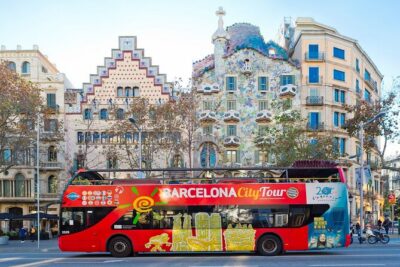
Barcelona City Tour Hop-On Hop-Off with Optional Boat
Read our review →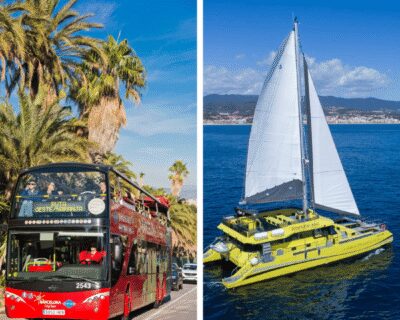
Barcelona: Hop-On Hop-Off Bus with Sailing Cruise
Read our review →
Barcelona Hop-On Hop-Off Bus and FC Barcelona Immersive Tour
Read our review →
Barcelona: Hop-On Hop-Off Bus and Moco Museum Ticket
Read our review →
Other lists with this bus tour