
Review · BUS TOURS
Riga: Red Bus Hop-On Hop-off Sightseeing Grand Tour
Riga’s best feature is its variety packed into a compact city. From the bus, you can move from the Daugava riverfront and ferry terminal to the Old Town, grand boulevards, Central Market, and Alberta Street’s fanciful Art Nouveau facades without arranging separate transport. I especially like the wide city overview and the chance to use the bus as a practical link between districts.
I also like the 12-language audio commentary, which gives useful context as you pass monuments and buildings. The main drawback is timing: this is not a constantly circulating bus. Departures may be an hour apart in summer and every 90 minutes in the cooler months, so the hop-on, hop-off idea works best when you plan your stops carefully.
Key points to know before boarding
- Start at Triangula Bastion: The main stop is beside 11 Novembra Krastmala 17, near Riga’s Old Town.
- See more than 80 sights: The route covers Pardaugava, the city centre, the Old Town, Central Market, the harbor, and the Art Nouveau District.
- Expect a slow hop-on rhythm: Buses depart about every 60 minutes in June through September and every 90 minutes from October through May.
- Use the audio guide for context: Commentary is available in English, German, French, Finnish, Italian, Spanish, Norwegian, Russian, Latvian, Lithuanian, Swedish, and Polish.
- Plan for two route sections: The red and blue lines together take about 1.5 hours, while the full ride without getting off is described as roughly 60 minutes.
- Check the pass validity: The details describe both a one-day ticket and a pass valid for up to 48 hours, so confirm the current terms when booking.
A useful first look at Riga from Triangula Bastion
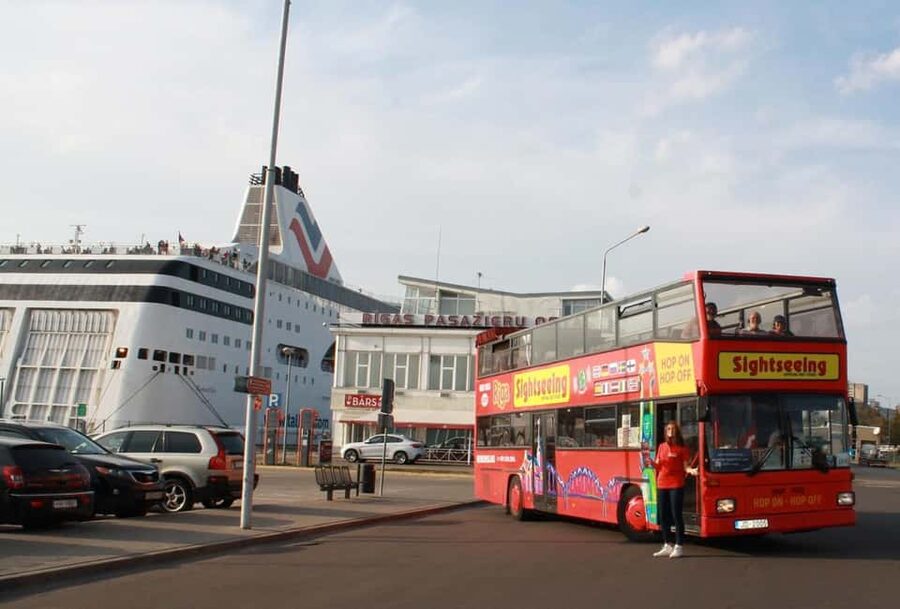
The bus begins near Triangula Bastion, on the edge of the Old Town beside the Daugava. This is a handy starting point because you are close to Riga’s historic centre, but you are also positioned for the river crossing and the wider city routes.
Before boarding, show your booking number to the driver so the voucher can be exchanged on the bus. The buses are easy to spot, though street stops have not always been clearly marked. Bring the route guide and map with you, and pay close attention to the stop names. That small bit of preparation can save you from waiting at the wrong corner.
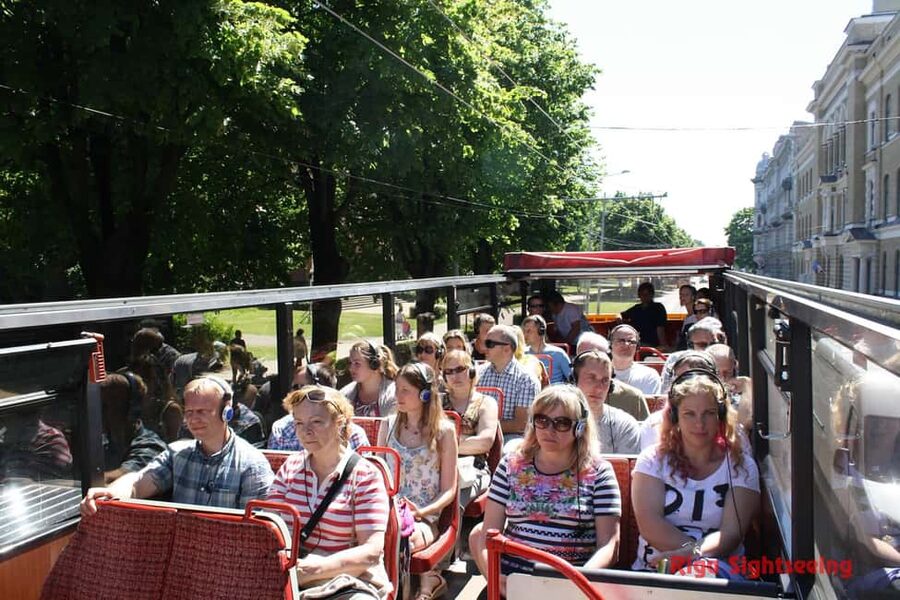
The ride is designed as an overview rather than a guided walking tour. You sit upstairs for the best views when the weather allows, plug in your headphones, and listen as the city passes by. The audio gives facts about the sights, but the timing does not always match the building directly outside your window. I would treat it as background information, then use the route to decide where to get off and explore on foot.
More Hop-On Hop-Off Bus Tours in the world:
- Barcelona: 24 or 48-Hour Hop-On Hop-Off Bus Tour
★ 4.4 · 20,872 reviews - Rome: City Sightseeing Hop-on Hop-off Bus with Audioguide
★ 4.0 · 16,045 reviews - Paris: Tootbus Hop-on Hop-off (Optional River Cruise)
★ 4.3 · 15,279 reviews
Pardaugava and the crossing of the Daugava
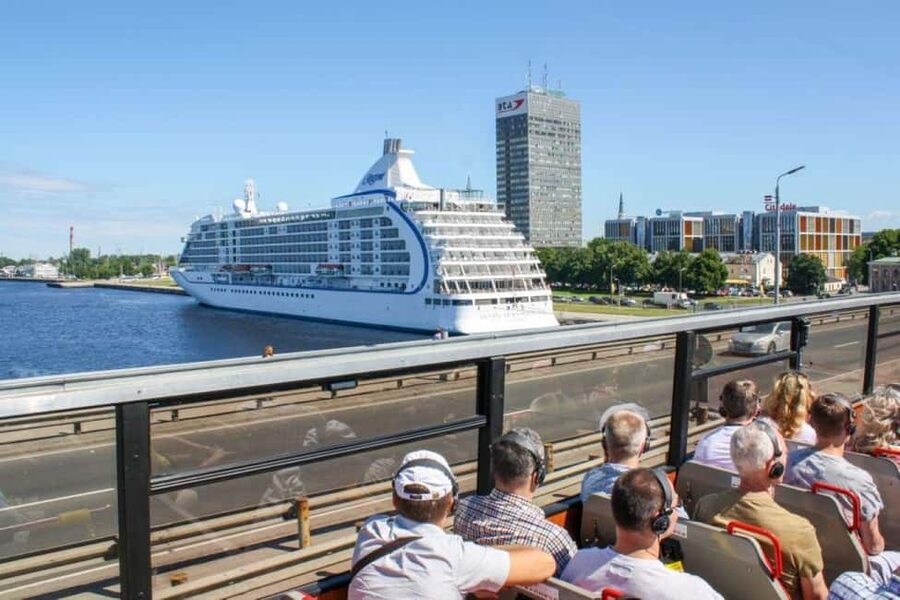
The first part of the route heads toward Pardaugava, the district on the left bank of the Daugava. From here, you get a different angle on Riga’s skyline, with old churches and cathedral towers visible across the water.
Crossing the Stone Bridge is one of the best moments of the ride. The bus opens up a broad view toward the Old City, including the cluster of church spires that gives Riga its famous skyline. This is a quick visual introduction to how the city is arranged, with the river separating the older centre from the neighborhoods beyond it.
Pardaugava is less likely to be your main sightseeing target than the Old Town or Art Nouveau District, but that is part of its value. You see Riga as a working city rather than a collection of postcard buildings. If you only have a short time in town, stay on the bus for this section first, then decide which central stops deserve more of your day.
The Old Town, Monument of Freedom, and Opera House
Back on the central side of the river, the bus passes the main historic sights. You will see the Old Town, the Boulevard Ring, the Monument of Freedom, the Latvian National Opera House, and the Powder Tower.
The ride gives you a good sense of scale. Riga’s centre is compact, but the sights are spread through several distinct areas. The bus is useful if you want to locate the Old Town, understand where the parks and boulevards begin, and see how the medieval core sits beside later city districts.
I would not use the bus as a substitute for walking through the Old Town. The vehicle can show you the outline, but narrow streets and historic squares are best explored at street level. Use the ride to choose your return point, then get off and spend time wandering without a schedule.
The Monument of Freedom is another natural stop for a walking break. From the bus, you get the formal view and some historical context. On foot, you can take a closer look at the monument and the surrounding boulevard area. The audio commentary helps with orientation, though it may not always tell you clearly that a particular sight deserves a longer stop. Keep your map open and make your own decisions.
Riga Central Market and the harbor
The route also passes Riga Central Market, one of the city’s major attractions and one of Europe’s largest covered markets. Its enormous market halls are a useful contrast to the polished facades of the Old Town and central boulevards.
The bus gives you a quick look, but Central Market rewards getting off. If food, local shopping, or everyday Riga interests you, allow time here rather than treating it as another photograph from the upper deck. The stop also helps connect the historic centre with the modern life of the city.
The harbor section includes the Riga Ferry Terminal. This is not the most ornate part of the route, but it broadens your view of Riga beyond churches and decorative buildings. You see the city’s riverfront and transport connections, which helps explain why the Daugava has mattered so much to Riga’s growth.
If you are taking the tour mainly for grand architecture, the harbor may feel like a quieter stretch. If you want a more rounded picture of the city, it is worth keeping in the route. The contrast is useful: Riga is not only a pretty Old Town, but also a port city with practical working districts.
More Sightseeing Bus Tours in the world:
- Barcelona: City Sightseeing Hop-On Hop-Off Bus Tour
★ 4.4 · 10,061 reviews - Rome: Big Bus Hop-on, Hop-off Open-Top Sightseeing Tour
★ 4.1 · 9,537 reviews - City Sightseeing London Hop-On Hop-Off Bus & Bookable Extras
★ 4.4 · 7,374 reviews - Hamburg: Line A Sightseeing Hop-On Hop-Off Bus Tour
★ 4.6 · 6,958 reviews
Art Nouveau Riga and Alberta Street
The strongest architectural section comes in the central Art Nouveau District. Riga is famous for its decorative facades, and the route lets you cover a lot of ground quickly before you choose which streets to explore on foot.
Alberta Street is the highlight. The buildings are covered with theatrical detail, including stone masks, mythical creatures, sculpted figures, and elaborate ornament. The facades are linked with the work of architect Mikhail Eisenstein, whose designs give the street a distinct, highly decorative character.
This is where the hop-on, hop-off format makes the most sense. You can see the area from the bus, note the stop, then return on foot to study the buildings at your own pace. The route presents many architectural styles, from Romantic forms to Art Nouveau, and the commentary adds useful background as you move between them.
The architecture is recognized by UNESCO as part of Riga’s architectural heritage. That matters less as a label than as a reminder to slow down here. Look above shopfront level, where the most interesting details are often found. The bus gives you the quick survey, but the real pleasure comes from walking, looking up, and comparing one facade with the next.
How the two routes work in practice
The service is often described as a red and blue route. One section takes about an hour, and the two together take roughly 1.5 hours, although the supplied timing also describes a full tour without stops as approximately 60 minutes. Treat those figures as estimates rather than a precise timetable.
The key practical issue is the wait between buses. In the high season, from June through September, an additional bus departs from Triangula Bastion about every 60 minutes. From October through May, the interval is about 1.5 hours.
That gap changes how you should use the ticket. Do not hop off at every interesting stop unless you have plenty of time. Instead, choose one or two main stops, check the next departure, and build your walking time around it. If you miss a bus, you may face a long wait.
The system can work well for a full day, especially if you want transport between the Old Town, Central Market, and Art Nouveau District. It is less useful if you expect a bus every 10 or 15 minutes. The tour’s greatest strength is coverage, not frequency.
Audio commentary, seats, and tour comfort
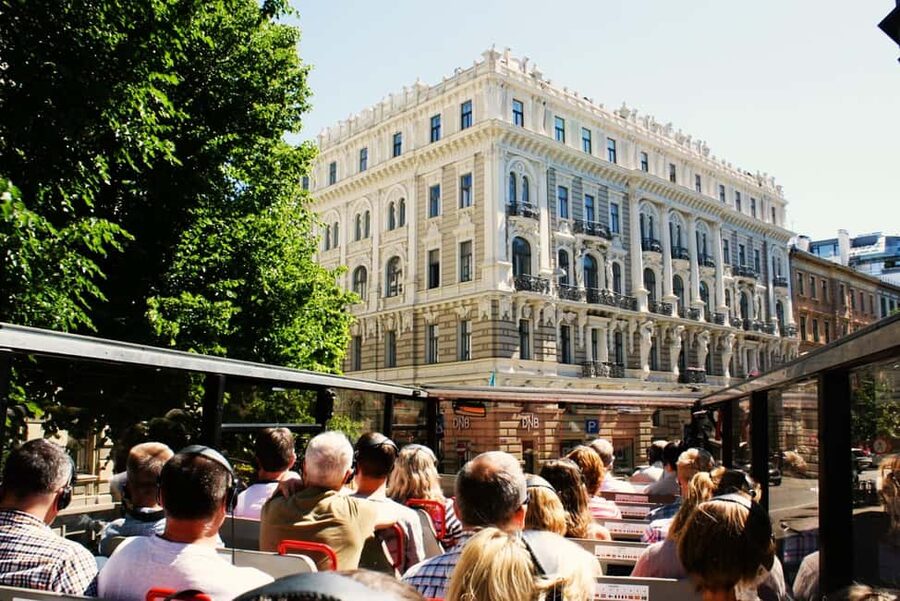
The recorded commentary is available in 12 languages, including English, German, French, Finnish, Italian, Spanish, Norwegian, Russian, Latvian, Lithuanian, Swedish, and Polish. That makes the tour accessible to a wide range of passengers, and the headphones let you listen without depending on a live guide.
The audio is generally informative, but the narration may not always line up perfectly with what you are seeing. I suggest looking at the route map while listening, especially during the central city section. That way, you can work out which sight is coming next and avoid missing a stop that interests you.
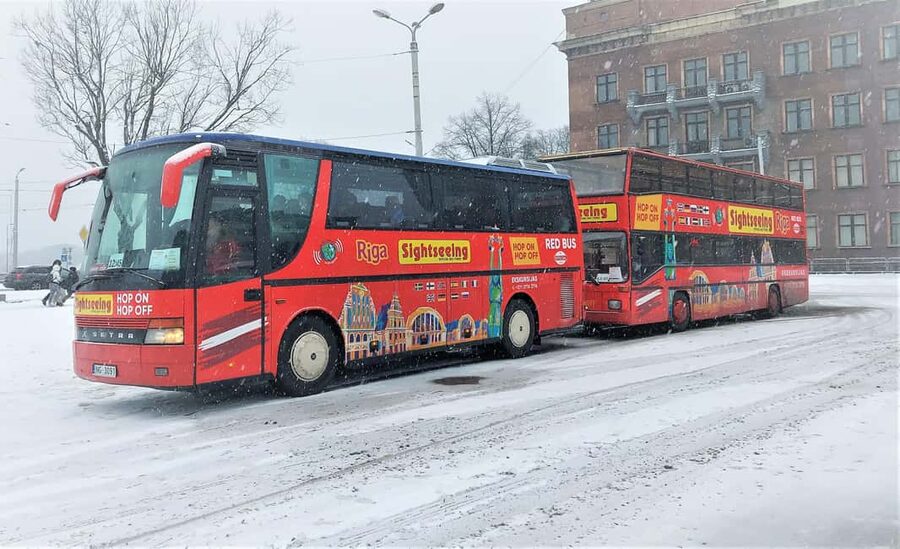
The buses are double-deckers, though one recent description refers to a comfortable minibus. The exact vehicle may vary. The upper deck offers the clearest views, but weather and temperature will affect how pleasant it is. The lower level is more sheltered and may be the better choice in cooler months.
There is no named live guide listed for this experience. The driver handles ticket exchange and route operation, while the recorded audio provides the sightseeing commentary. Drivers have been described as polite and helpful, but you should not expect the personal interaction of a walking tour led by a local guide.
Is $29 a fair price for one day?
At $29 per person, the ticket is reasonable if you use it as both a sightseeing circuit and transport between several districts. It gives you the city map, route information, multilingual audio, and access to more than 80 sights. For a first day in Riga, that can save time and help you understand where everything fits.
The value drops if you stay on for only one short loop. Riga’s central sights are fairly close together, and much of the Old Town can be covered on foot. One passenger found the cost high for a relatively small city, a fair criticism if you are comfortable walking and have plenty of time.
I would consider the price worthwhile in three situations:
- You are visiting Riga for only a day and want a fast overview.
- You want to reach the Art Nouveau District, Central Market, and riverfront without working out several connections.
- You prefer recorded explanations to exploring every sight without context.
If you plan to walk everywhere and mainly want the Old Town, save the money for a museum, meal, or separate activity. If you use the bus across several stops and get off for proper walks, the price makes more sense.
The booking terms need a quick check. The activity is described in one place as valid for one day from first activation, while the included ticket is also described as valid for two days, up to 48 hours. Confirm which version applies to your booking before you pay, particularly if you are planning to spread the routes over two days.
Who will get the most from this Riga bus tour?
This is a good match for first-time visitors who want an organized introduction without committing to a long walking tour. It also suits families, since the moving view of the city can be easier for children than a lengthy architectural walk.
It works well for anyone with limited mobility or anyone who wants to reduce the amount of walking between districts, although the supplied information does not specify accessibility arrangements. Contact the operator if that point matters to you.
Architecture fans should use the bus as a preview for a longer walk around Alberta Street and the surrounding Art Nouveau streets. History-minded visitors will appreciate the commentary around the Old Town, Monument of Freedom, Opera House, and Powder Tower, though the recording cannot answer personal questions or adjust its pace.
You should be comfortable with a slower schedule. The long gaps between buses mean that this is not a tour for making dozens of quick stops. It rewards a simple plan: ride the full circuit first, choose your priorities, then use the pass for one or two well-timed outings.
Should you book the Red Bus Grand Tour?
Book it if you want a broad first look at Riga, especially if you have one day and want to connect the riverfront, Old Town, Central Market, and Art Nouveau District. The views from the Stone Bridge and the architectural section around Alberta Street are the main reasons to choose it.
Skip it if you prefer walking, already know the city, or expect frequent buses. Riga is compact enough that independent exploration can be cheaper and more flexible. For most first visits, though, the bus is a sensible orientation tool, as long as you plan around the 60 to 90 minute service intervals and confirm whether your ticket lasts one day or up to 48 hours.
FAQ
Where does the Riga Red Bus tour start?
The main stop is near Triangula Bastion at 11 Novembra Krastmala 17 in Riga’s Old Town.
How long does the full bus ride take?
The full ride without stops is listed as approximately 60 minutes. The red and blue route sections together are also described as taking about 1.5 hours, so allow extra time for route changes and traffic.
How often do the buses run?
From June through September, an additional bus departs about every 60 minutes. From October through May, departures are about every 1.5 hours.
How many stops are on the route?
There are 11 main stops and about six additional stops along the routes.
Which parts of Riga does the bus cover?
The routes pass through Pardaugava, the Old Town, the central city, the Boulevard Ring, the harbor, Riga Ferry Terminal, Central Market, and the Art Nouveau District.
Is audio commentary included?
Yes. Recorded commentary is included through headphones in 12 languages, including English, German, French, Spanish, Italian, Latvian, Lithuanian, Russian, Swedish, Norwegian, Finnish, and Polish.
Do I need to exchange my voucher?
Yes. Show your booking number to the bus driver so the voucher can be exchanged on the bus.
What ticket validity is provided?
The information describes the activity as valid for one day from first activation and also describes the included ticket as valid for two days, up to 48 hours. Confirm the current validity when booking.
How much does the tour cost?
The listed price is $29 per person.
Can I cancel the booking?
You can cancel up to 24 hours in advance for a full refund. A reserve-now, pay-later option is also provided.
Just joined the route map around the world
- San Pedro de Atacama: Vallecito + Magic Bus★ 5.0 · 4 reviews
- Santander: City Sightseeing Hop-On Hop-Off Bus Tour & Train★ 4.3 · 170 reviews
- Santiago: 1-Day Hop-On Hop-Off Bus and Cable Car Ticket★ 4.3 · 332 reviews
- San Francisco: Sightseeing Sunset Tour by Open-Top Bus★ 4.4 · 105 reviews
- San Francisco: Movie Filming Locations Bus Tour★ 4.9 · 368 reviews
- San Fransisco: Vintage VW Bus Wine Country Tour Small Group★ 5.0 · 5 reviews
- SF: Napa & Sonoma Wine Tour & Hop-on Hop-off Tour (Save 15%)★ 4.5 · 2 reviews
- San Francisco: Hop-On Hop-Off Tour with Optional Night Tour★ 4.5 · 94 reviews