
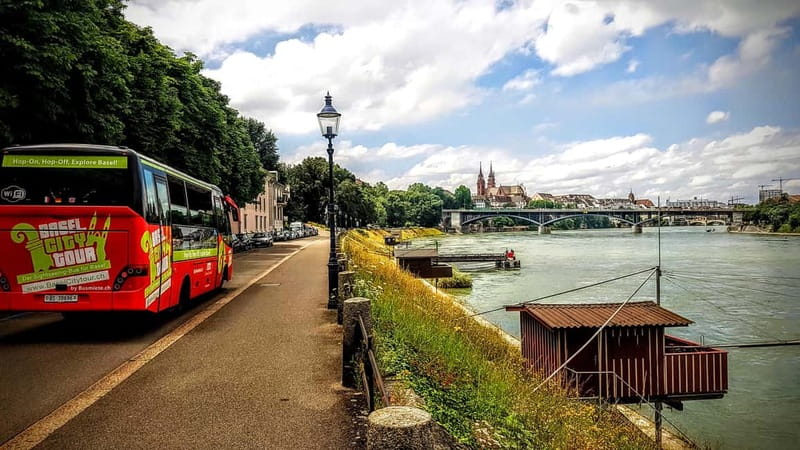
Review · SWITZERLAND
Basel: Sightseeing Bus Tour with Audio Guide
Basel’s story comes in layers here: medieval gates, modern pharmaceutical towers, art museums, and the three-country meeting point at Dreiländereck. This two-hour panoramic bus ride gives you a useful first look at a city that can feel scattered when you arrive.
I like the clear iPad audio system, which pairs narration with photos and videos, and I like the chance to step off at places such as St. Johanns-Park and Dreiländereck. The free Läckerli biscuit is a pleasant local touch. The catch is weather: the covered bus can still feel hot in summer, and the audio may occasionally slip out of sync with the view.
- Basel in one sweep: Follow a route from the Tinguely Fountain through the old town, industrial north, Rhine waterfront, and museum district.
- Three-country viewpoint: Stop at Dreiländereck, where Switzerland, France, and Germany meet.
- Useful audio guide: Choose from Chinese, English, German, Italian, Japanese, Arabic, French, and Spanish.
- Good first-day activity: Use the ride to decide which museums, streets, and landmarks deserve a closer visit.
- Small local extra: Try a Basel Läckerli, a traditional hard spice biscuit, during the tour.
- Flexible sightseeing: The bus has 12 stops for boarding and getting off, though this is not a hop-on, hop-off ticket described with unlimited riding.
A Fast Introduction to Basel’s Many Sides
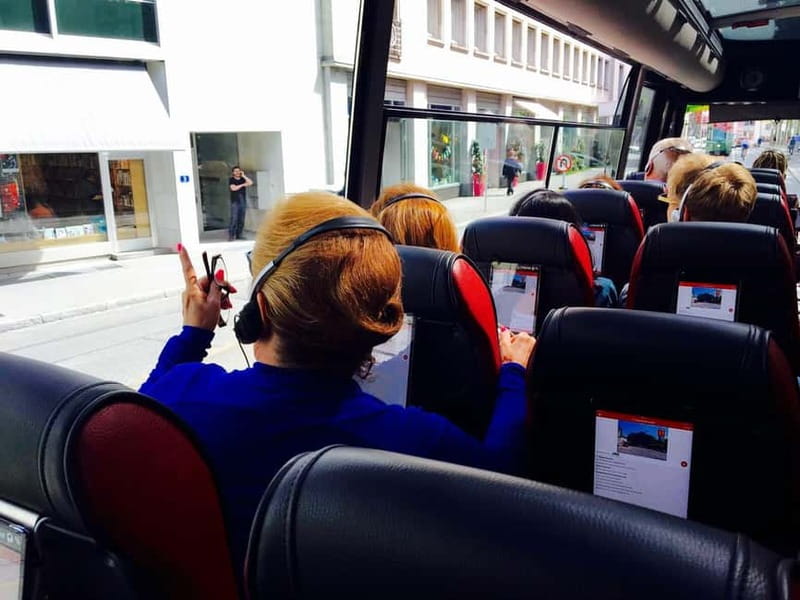
The tour begins at Steinenberg 4, opposite the Tinguely Fountain and in front of Stadtcasino. That is a central starting point, close to the old town and easy to connect with on foot. Look for the bus parking zone rather than expecting a large indoor terminal. One practical complaint has been that the meeting point can be a little hard to spot, so arrive with the exact address ready on your phone.
You receive an iPad with the audio guide app and headphones. The system is more than a voice track: it can show images and other visual material while you pass the sights. That helps when a building is difficult to identify from a moving bus. Bring a charged smartphone as requested, and dress for the weather. Free WiFi is available on board.
The route is designed as a broad introduction, not a close study of Basel’s old town. You will see far more than you could cover on foot in two hours, but many landmarks are viewed through the windows. The two scheduled photo stops, at St. Johanns-Park and Dreiländereck, give you the clearest chance to stretch your legs.
From the Tinguely Fountain to the Old Town
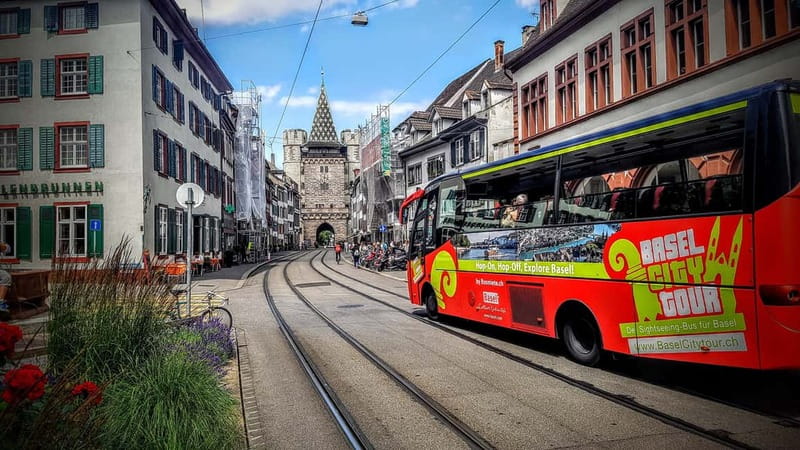
The Tinguely Fountain is an apt starting point. Jean Tinguely’s playful mechanical sculptures send water into motion, and the fountain immediately signals Basel’s strong connection with modern art. The bus then passes Markthalle Basel, St. Paul’s Church, the city synagogue, and the University of Basel.
This early section helps you place Basel’s institutions around the center. You hear about subjects ranging from politics and education to people connected with science, medicine, religion, and literature. Names linked to the narration include Paracelsus, the Bernoulli family, Hermann Hesse, C. G. Jung, and Theodor Herzl.
The Bernoullianum, University of Basel, and Fischmarkt fountain lead toward Marktplatz. At the market square, the red Town Hall is the visual prize. Its painted façade and rich color are easy to miss if you are rushing through town on foot, so the bus gives you a useful first sighting. You also pass the canton offices and other central buildings before reaching the Rhine.
This is one place where the audio guide matters. A quick city ride can turn into a blur of façades unless someone explains why a building or person matters. Still, the narration is not always perfectly matched to the view. Keep watching the street and use the images on the iPad as a backup.
More Sightseeing Bus Tours in Switzerland:
- Zurich: City Highlights Tour by Bus, Cable Car, and Ferry
★ 4.4 · 2,366 reviews - Chamonix & Mont Blanc Panoramic Sky-Glass Bus Guided Day Trip
★ 4.0 · 1,324 reviews - Geneva: Open-Top Sightseeing Bus Tour
★ 3.7 · 634 reviews
Läckerli and Basel’s Everyday Traditions
A small food stop introduces you to Jakob’s Basler Leckerly Manufaktur. The included treat is a Läckerli, Basel’s traditional hard spice biscuit. It is firm, sweet, and flavored with spices, a snack that feels more connected to the city than a generic packaged refreshment.
The biscuit is a nice idea, but check that it is actually offered during your departure. Some passengers found the box empty. One person also felt the repeated promotion of the biscuit and a Nestlé product took attention away from the sightseeing. I would treat the Läckerli as a bonus, not a reason to book the tour.
Food aside, this section helps you understand the difference between seeing Basel and simply collecting photographs. Small local details, including confectionery, old family businesses, and food traditions, give the city a more human scale. You can always buy a full box later if the sample leaves you wanting more.
St. Johanns-Tor and Basel’s Northern Edge
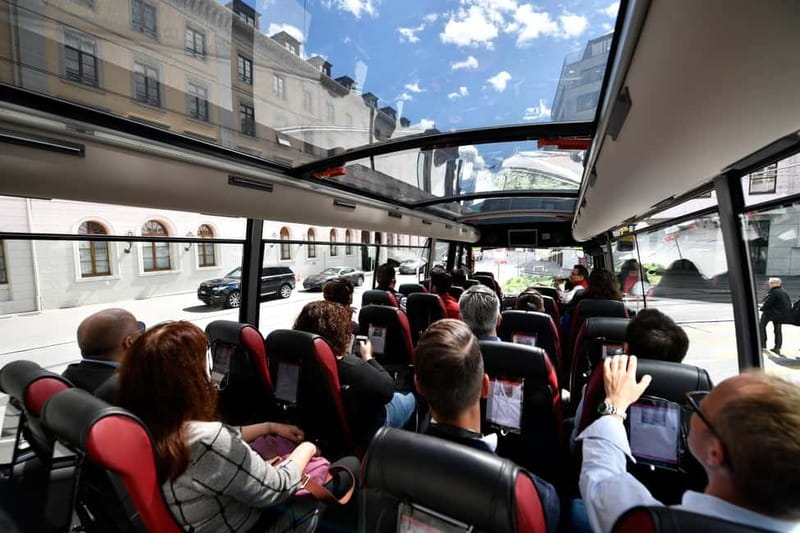
The bus continues past St. Johanns-Tor, one of Basel’s surviving city gates, and St. Johanns-Park. The gate is a reminder that the city once had a fortified boundary, while the park gives you a greener view near the Rhine.
The stop at St. Johanns-Park lasts about seven minutes. That is enough for a quick photograph and a short stretch, but not enough for a relaxed park visit. Keep your belongings close and pay attention to the departure time. This is a timed sightseeing stop, not an invitation to wander.
Next comes the Novartis Campus, a major part of Basel’s modern business identity. The route also passes the site of a Celtic settlement near the old gasworks. That contrast is one of the tour’s best ideas: you move from ancient settlement to present-day science and industry within a short distance.
The narration covers Basel’s economy, companies, and industrial development, including Novartis and the history connected with Fritz Hoffmann-La Roche. If you mainly want medieval streets, this northern section may feel less scenic. If you want to understand why Basel is an important center for pharmaceuticals and business, it adds useful context.
Dreiländereck, Where Three Countries Meet
The ten-minute photo stop at Dreiländereck is the route’s most distinctive pause. Basel sits near the borders of France and Germany, and this point marks the meeting of all three countries. It is not a grand medieval monument. Its value comes from geography and from Basel’s role as a border city.
You have enough time for photographs and a quick look around, but do not expect a long visit. The tour uses the stop to show how the Rhine and the borders shape the city. The audio stories also touch on people, commerce, and the development of Basel as a place connected to its neighbors.
The bus then passes Stücki Park and the Thomy factory before returning toward the exhibition center. This part of the ride can feel more ordinary because it includes commercial and industrial areas. That is also why it is useful. Basel is not only cathedral towers and art museums. It is a working city, with offices, factories, trade fairs, and research centers.
More bus tours with commentary around Switzerland:
- Zurich: City Bus Tour with Audio Guide and Lake Cruise
★ 4.3 · 1,195 reviews - Rome: City Sightseeing Hop-on Hop-off Bus with Audioguide
★ 4.0 · 16,045 reviews - Milan: City Sightseeing Hop-On Hop-Off Bus with Audio Guide
★ 4.0 · 6,256 reviews - London: Christmas Lights Bus Tour With Live Guide
★ 4.0 · 5,410 reviews
From the Exhibition Center to the Rhine
The route crosses toward Basel-Wettstein and passes the Sankt Alban ferry area. You may see how the Rhine divides the city into distinct districts, with Grossbasel on one side and Kleinbasel on the other. The bus is a good way to connect areas that might seem separate when you are walking around the old town.
The Hoffmann-La Roche complex and Roche Tower bring the city’s modern skyline into view. Roche Tower, sometimes called the Big Roche, is one of Basel’s most recognizable contemporary structures. It gives the tour a strong visual counterpoint to the cathedral and old city gates.
The audio guide includes stories about industry, architecture, and people such as Felix Sarasin and Wettstein. It also touches on unusual links to Lenin, Thomy, and the Basilisk, Basel’s mythical creature and city symbol. You do not need to remember every name. The value is in hearing how politics, business, architecture, and folklore overlap in a compact city.
Tinguely Museum and the Southern History of Basel
The bus passes the Museum Tinguely, a natural companion to the opening view of the Tinguely Fountain. If you enjoy kinetic art, note its location for a later visit. The museum is easier to appreciate when you have already seen how Tinguely’s machines animate public space.
The route then moves by Basel’s city wall, the Basel Paper Mill, and Schöneck Fountain. The city wall and old gates make the medieval outline easier to understand, while the Paper Mill points to Basel’s long connection with printing and paper production. This is particularly relevant in a city shaped by books, universities, publishing, and trade.
You also pass the Fine Arts Museum Basel, one of the city’s major art institutions. This museum, the Tinguely Museum, the cathedral, and the historic center form a strong follow-up plan after the bus ride. I recommend noting each one on the iPad or map instead of trying to see everything later from memory.
Basel Cathedral and Elisabethenkirche
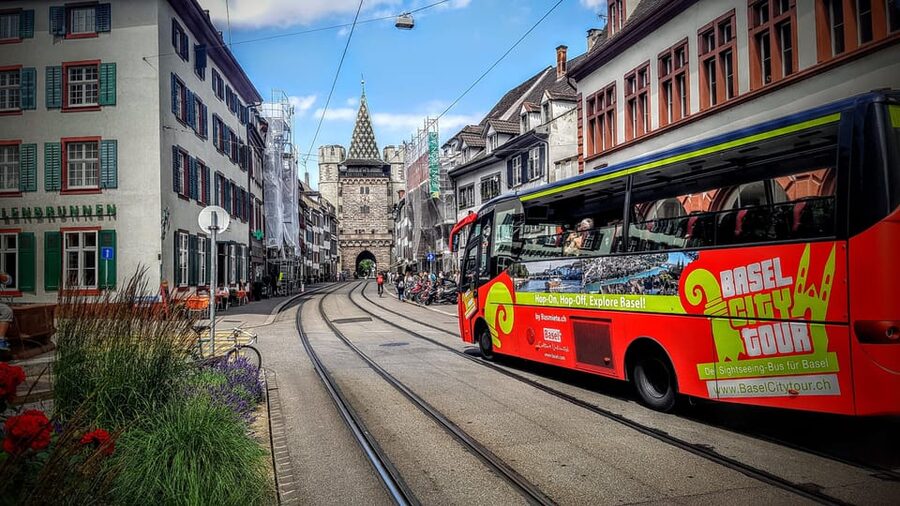
Basel Cathedral is one of the main visual anchors of the city, with its twin towers and position above the Rhine. From a bus window, you get a useful orientation, but not the full pleasure of the building. The cathedral deserves a separate walk, especially if you want to inspect its stonework, plaza, and river views.
Elisabethenkirche rounds out the central section of the route. The church is near the theater district and offers another example of Basel’s religious architecture. The ride does not replace walking through the old town, but it tells you where to begin once you leave the bus.
The tour returns to the Tinguely Fountain. By then, you have seen the historic core, both sides of the Rhine, the northern business area, museums, city gates, and the border point. The route is broad rather than slow, so plan to revisit the places that caught your eye.
How Good Is the Audio Guide?
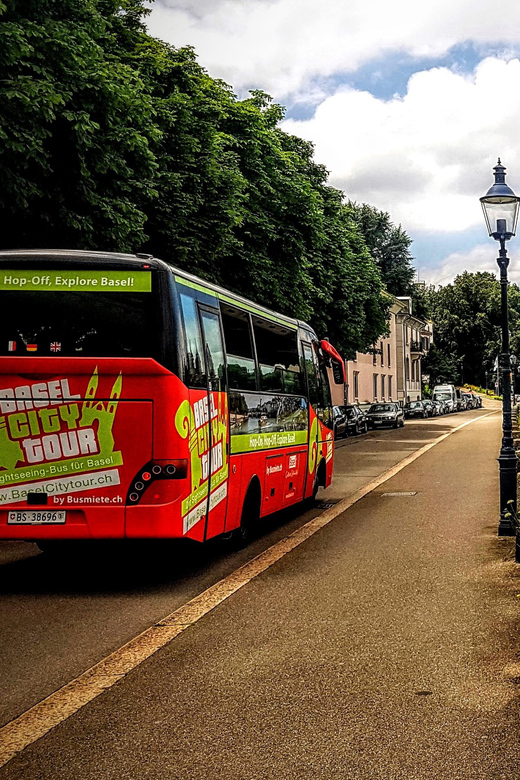
The audio guide is one of the strongest parts of this experience. It is available in eight languages: Chinese, English, German, Italian, Japanese, Arabic, French, and Spanish. The combination of spoken narration and iPad images is helpful for visitors who want more than a passing view.
The content reaches beyond dates and building names. You hear about art, architecture, economics, politics, religion, science, and the growth of Basel. The list of subjects includes Christoph Merian, Sheik Ibrahim, BIZ, Anne Frank, Johann Peter Hebel, Wolfgang Goethe, Herzog and de Meuron, Jean Tinguely, and others.
There are limits. The narration can occasionally begin before the previous audio has finished, and some iPads may not work properly. Headphones have also had one-sided sound problems. If the audio gets out of step, look at the screen and the street rather than trying to force every sentence to match the exact building outside.
The driver is not presented as a live historian, but the driver can still affect the experience. Drivers have been described as friendly and helpful, and one driver received praise for giving useful support during the stops. Treat the audio as the main guide and the driver as your practical point of contact.
Comfort, Weather, and Timing
The bus is covered, which makes this a reasonable choice for rain or cold weather. It also has free WiFi, and the ride gives you a dry way to get familiar with Basel before committing to a long walk.
Summer requires more thought. The windows may be open, and the interior can become hot, especially if the bus has been sitting in direct sun. Some seats have felt hot before departure, and air conditioning has not always matched the outdoor temperature. Bring water, wear light clothing in warm weather, and avoid assuming that a covered bus will be cool.
The advertised duration is two hours. Because the ride includes photo breaks, a food sample, boarding activity, and traffic through a city center, the actual moving sightseeing can feel shorter. One timed stop lasts about seven minutes and another about ten minutes, so the full period is not two continuous hours of narration.
The route also depends on city traffic. One departure experienced a bus breakdown, an uncommon but real transport risk. If you have a train, flight, or timed museum entry afterward, leave a generous buffer.
Is $25 a Fair Price?
At $25 per person, the tour is reasonably priced if you use it as an orientation ride. You get the bus, audio guide, WiFi, Läckerli sample, and access to 12 stops for boarding and getting off. A private guide would cost far more, while a normal public bus would not explain the sights or provide the same route.
The value drops if you want a slow old-town walk or detailed access to museums. Most landmarks are seen from the vehicle, and the short stops do not allow long visits. You are paying for coverage and context, not admission to attractions.
I find the best value on a first day in Basel, especially when rain, heat, limited time, or tired feet make a full walking tour less appealing. Use the ride to mark the cathedral, museums, city gates, Rhine crossings, and Dreiländereck for later.
Free cancellation up to 24 hours before departure and reserve-now, pay-later booking make the purchase less risky. Starting times vary, so check availability for your date.
Who Should Book This Basel Bus Tour?
I would choose this tour if you want a quick city overview, need narration in one of eight languages, or are visiting Basel for the first time. It also suits families and older visitors who prefer to cover long distances without constant walking.
It works well on a rainy day because the bus is covered. It can also help on a hot day, but only if you are comfortable with open windows and possible heat inside the vehicle.
I would skip it if your main goal is intimate exploration of the old town. A walking tour gives you more time at the Town Hall, cathedral, market square, and narrow streets. I would also think twice if you dislike recorded narration or want a fully live, question-and-answer guide.
Final Booking Advice
Book this BaselCitytour experience when you want to get your bearings fast. The route’s strongest moments are the iPad-supported narration, the contrast between medieval Basel and the Roche and Novartis districts, and the unusual stop at Dreiländereck.
Go with realistic expectations: some sights pass quickly, the audio can occasionally drift from the view, and the biscuit is not guaranteed to be available at every departure. If you accept those limits, $25 buys a practical introduction to a complex city, with enough clues to plan the rest of your Basel stay.
FAQ
Where does the Basel sightseeing bus tour start?
It starts at BaselCitytour Bus Stop 01 at Steinenberg 4, opposite the Tinguely Fountain and in front of Stadtcasino, in the bus parking zone.
How long does the tour last?
The advertised duration is two hours, including the bus ride and scheduled stops.
What languages are available for the audio guide?
The audio guide is available in Chinese, English, German, Italian, Japanese, Arabic, French, and Spanish.
Is the audio guide included in the price?
Yes. An iPad with the audio guide app is included, and the audio guide app can also be downloaded for free.
Does the bus have WiFi?
Yes. Free WiFi is available on board.
Is food included?
A traditional Basel Läckerli biscuit is included. Meals and drinks are not included.
Can I get off the bus during the tour?
The tour includes 12 stops for boarding and getting off. The described route includes a photo stop of about seven minutes at St. Johanns-Park and another of about ten minutes at Dreiländereck.
What sights does the bus pass?
The route passes the old town, Marktplatz, Basel Town Hall, Middle Bridge, St. Johanns-Tor, Novartis Campus, Dreiländereck, Stücki Park, Roche Tower, Museum Tinguely, the city wall, Basel Paper Mill, Basel Cathedral, and the Fine Arts Museum, among other sites.
What should I bring?
Bring weather-appropriate clothing and a charged smartphone. Headphones and an iPad for the audio guide are provided as part of the tour.
More ride-at-your-own-pace passes around Switzerland
- Trieste Bus Tour with Audio Guide
★ 4.4 · 2,170 reviews - Los Angeles: Hop-On Hop-Off Bus Tour with Audio Guide
★ 3.7 · 2,030 reviews - Istanbul: Hop-On-Hop-Off with Optional Audio Tour or Cruise
★ 4.2 · 1,058 reviews - Toulouse: City Sightseeing Tour by Bus with Audio Guide
★ 4.2 · 956 reviews
Just joined the route map around Switzerland
- Rhine fall Visit and Zurich Open Top City Tour★ 4.7 · 6 reviews
- From Zurich: Rhine Falls Coach Tour with Entry Tickets★ 4.7 · 722 reviews
- From Milan: Bernina Express Train and St. Moritz Tour by Bus★ 4.6 · 29 reviews
- Geneva: Hop-on Hop-Off Bus & Scenic Mini-Train Tour★ 3.8 · 501 reviews
- Geneva: Open-Top Sightseeing Bus Tour★ 3.7 · 634 reviews
- Zurich: City Bus Tour with Audio Guide and Lake Cruise★ 4.3 · 1,195 reviews
- Chamonix & Mont Blanc Panoramic Sky-Glass Bus Guided Day Trip★ 4.0 · 1,324 reviews
- From Interlaken: Guided Tour to Jungfraujoch – Top of Europe★ 4.7 · 1,649 reviews
Switzerland Bus Tours, side by side.

Zurich: Day Trip to Grindelwald, Interlaken & Lauterbrunnen
Read our review →
From Zurich: Bus Day Trip to Heidiland and Liechtenstein
Read our review →
Zurich: City Highlights Tour by Bus, Cable Car, and Ferry
Read our review →
Chamonix & Mont Blanc Panoramic Sky-Glass Bus Guided Day Trip
Read our review →
Zurich: City Bus Tour with Audio Guide and Lake Cruise
Read our review →
From Zurich: Rhine Falls Coach Tour with Entry Tickets
Read our review →

Geneva: Hop-on Hop-Off Bus & Scenic Mini-Train Tour
Read our review →Other lists with this bus tour