
Review · BUS TOURS
Buenos Aires Hop-On Hop-Off Bus, Free Walking Tours & Discounts
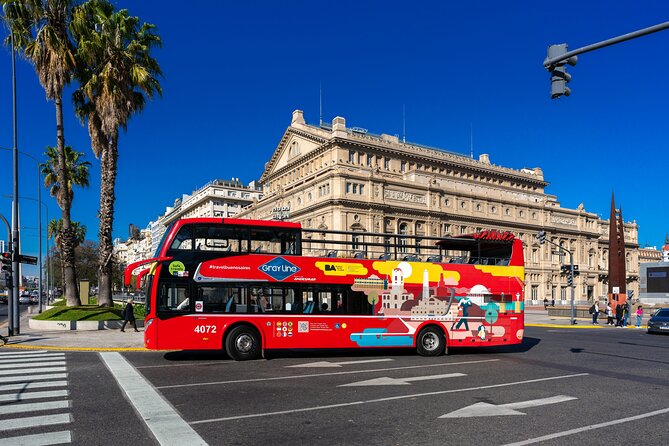
Buenos Aires is too spread out for a quick walking tour, and this bus gives you a useful first look at its grand avenues, football districts, riverfront, and northern neighborhoods. I like the freedom to hop off at places such as San Telmo, La Boca, Recoleta, and MALBA instead of following a fixed group.
I also like the full-city route, which takes about three hours without getting off. You can ride once to get your bearings, then return to the areas that catch your eye. The main drawback is practical: stops can be hard to find, route details sometimes change, and the audio may not match the bus position.
Key Points At A Glance
- A three-hour city loop: Ride from Congreso through San Telmo, La Boca, Puerto Madero, Recoleta, Palermo, and Núñez.
- Three pass choices: Select a 1, 2, or 3-day ticket, with the pass beginning when you activate it.
- Open-top viewing: The double-decker layout gives you good photo angles, with air conditioning and a sunroof for comfort.
- Walking tours included: Optional tours operate on a voluntary payment system and depend on weather and operating conditions.
- Useful for a first day: The route helps you compare neighborhoods before deciding where to spend more time.
- Plan around weak points: Several stops lack clear signs, and some announcements may be out of sync with the map.
The Best Use Of This Bus: Get Your Buenos Aires Bearings
The route covers a lot of ground. That matters in Buenos Aires, where the major sights are spread across distinct areas rather than gathered around one compact old center.
I would use the bus in one of two ways. If you have only a day, ride much of the loop first, then get off at one or two places that interest you. If you have a 2 or 3-day pass, use the first ride as an orientation and save the following days for stops such as La Boca, Recoleta, MALBA, or Puerto Madero.
The complete circuit takes about three hours, depending on traffic. Buenos Aires traffic lights and congestion can make the ride slow, so do not build a tight schedule around several exact departures. The full loop is best treated as a moving city introduction, not a fast taxi ride.
The listed price is $39 per person, though the final value depends on the pass length and any additional activities attached to the option you choose. It is easier to justify for a first visit, a short stay, or anyone who wants to see distant districts without arranging separate transport. If you are comfortable using the metro and walking, you may find a single day is enough.
More Hop-On Hop-Off Bus Tours in the world:
- Barcelona: 24 or 48-Hour Hop-On Hop-Off Bus Tour
★ 4.4 · 20,872 reviews - Rome: City Sightseeing Hop-on Hop-off Bus with Audioguide
★ 4.0 · 16,045 reviews - Paris: Tootbus Hop-on Hop-off (Optional River Cruise)
★ 4.3 · 15,279 reviews
Starting At Diagonal Norte And Congreso
The central route begins at Diagonal Norte, at Avenida Presidente Roque Sáenz Peña 728, and continues to Congreso at Avenida Rivadavia 1545. This is a good place to start if you are staying near the central avenues or want a quick look at Buenos Aires civic core.
Congress gives you access to the monumental heart of the city. The bus is especially useful here because the route connects this area with districts that are not close enough for a pleasant walk in one outing.
The next stop is Paseo de la Historieta, at Avenida Independencia 311. This stop connects with Buenos Aires comic culture and works well for a short pause before moving toward San Telmo. Check the bus map and stop number carefully, since the numbering heard onboard has sometimes differed from the printed material.
San Telmo, Usina del Arte, And The Football Stops
San Telmo and Plaza Dorrego are at Avenida San Juan 350. This is one of the most useful stops for anyone interested in old streets, antiques, cafés, and the city’s street life. Give yourself time here if you want more than a quick photograph. Plaza Dorrego is a place to walk, not just view from the upper deck.
Next comes Usina del Arte at Agustín R. Caffarena 51. The former power station is a cultural venue in the La Boca area, and the stop gives you a different side of the district than the usual Caminito visit.
The Bombonera stop, at Brandsen 805, serves the famous Boca Juniors football stadium. If football matters to you, this is an obvious place to leave the bus. If it does not, you may prefer to continue to Caminito, since the two stops serve different parts of the same southern district.
The La Boca and Caminito stop is at Avenida Don Pedro de Mendoza 2163. Caminito is known for its brightly painted buildings, street art, tango atmosphere, and tourist shops. It is one of the most recognizable parts of Buenos Aires, but it is also one of the places where you should stay aware of your surroundings and keep valuables secure.
A walking tour may be available around selected stops, including La Boca and Puerto Madero. These tours are optional and use a voluntary payment system for the guide, so free means there is no fixed tour charge, not that tipping is forbidden. Ask the guide onboard to reconfirm the time and meeting point before getting off.
Costanera Sur And Puerto Madero
The bus uses different Costanera Sur stops depending on the day. From Monday through Friday, it lists Avenida Dr. Tristán Achával Rodríguez 337. On Saturday and Sunday, it uses Julieta Lanteri 1700.
That change is important. Do not assume the weekday location will apply on a weekend. Route changes and stop moves have caused confusion, so check the current map and ask the onboard staff before leaving the bus.
Puerto Madero follows at Avenida Alicia Moreau de Justo 930. This former dock district has broad pedestrian paths, modern buildings, restaurants, and water views. It is an easy place to spend a few hours, especially if you want a break from the bus.
The Estación Fluvial stop at Cecilia Grierson 320 continues the waterfront portion of the route. The bus gives you a broad view of how the older central districts connect with the newer dockside development. It is also a useful link if you want to combine the bus with an independent walk.
More bus tours around the world:
- Mt Fuji and Hakone 1-Day Bus Tour Return by Bullet Train
★ 5.0 · 26,383 reviews - London: Warner Bros. Studio Harry Potter Tour & Branded Bus
★ 4.7 · 19,194 reviews - Amsterdam: Zaanse Schans, Edam, Volendam & Marken Bus Tour
★ 4.6 · 15,034 reviews - 1-Day Tokyo Bus Tour
★ 5.0 · 14,250 reviews
Galerías Pacífico, El Ateneo, And Plaza San Martín
The bus then returns toward central Buenos Aires, stopping at Galerías Pacífico at Avenida Córdoba 787. This grand shopping center is known for its architecture and interior murals. It is a practical stop for a meal, shopping, or a short indoor break on a hot afternoon.
At Avenida Callao 927, the El Ateneo stop serves the well-known bookstore housed in a former theater. This is one of the route’s more distinctive stops. You do not need to be a serious reader to appreciate the old theater setting, and it is a good place to trade the traffic noise for a calm indoor visit.
Plaza San Martín, at Avenida Santa Fe 808, brings you into another central area with formal gardens, monuments, and grand buildings. These central stops are close enough to connect with your own walking plans, but distances between them can still be longer than they look on a small map.
The Teatro Colón stop at Cerrito 892 comes later in the circuit. The theater is one of the city’s major cultural landmarks, and this stop is convenient if you have a performance, guided visit, or simply want to see the building. The bus is not a substitute for a theater tour, but it helps you fit the area into a larger city day.
Recoleta, MALBA, And Buenos Aires Museums
The route turns north toward some of the city’s most popular cultural stops. Floralis Genérica is at Avenida Presidente Figueroa Alcorta 2800. The large metal flower sculpture makes an easy photo stop, and its broad setting is a welcome change after the tight central streets.
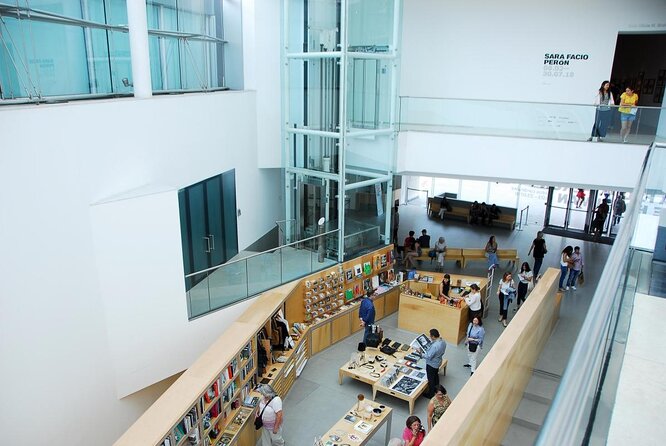
MALBA follows at Avenida Presidente Figueroa Alcorta 3465. The museum focuses on Latin American art and is one of the stronger reasons to choose a longer pass. You can get off for the museum, then continue later without rebuilding your entire day around a taxi or separate bus.
Recoleta is at Avenida del Libertador 1480. This district is a natural place to spend time on foot, with cafés, formal public spaces, and cultural attractions. The bus stop is useful, but you should allow walking time because the stop itself does not put every sight directly in front of you.
The Museo Nacional de Arte Decorativo is at Avenida del Libertador 1920. This stop suits visitors who want an interior visit rather than another outdoor landmark. The route groups several northern cultural attractions together, but do not assume you can see them all quickly. Pick one or two based on your interests.
Planetario, Aeroparque, And The Riverfront
The Planetario stop is at Avenida Sarmiento 3866, in the Palermo area. The route then continues to Club de Pescadores at Avenida Costanera Rafael Obligado 2610 and Aeroparque at Avenida Costanera Rafael Obligado 1055.
These stops show a quieter, more open side of Buenos Aires. The riverfront can feel far removed from the dense center, and the upper deck gives you a good view while the bus moves along the long avenues.
Another stop at Avenida Costanera Rafael Obligado 6745 serves Parque de la Memoria. This is a more serious and reflective visit than the sightseeing stops farther south. Give it time if you get off. It is not a quick photo stop, and its purpose is best understood at a slower pace.
Traffic can make this part of the route take longer than expected. If you have a flight or a separate appointment near Aeroparque, do not rely on the bus for precise timing.
Monumental, Barrio Chino, And Palermo’s Wide Avenues
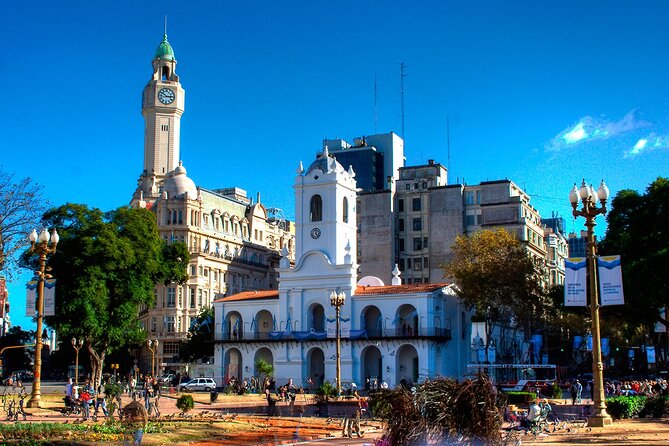
The Monumental stop at Avenida Presidente Figueroa Alcorta 7576 serves the River Plate football stadium. It is the northern counterpart to the Bombonera stop. Football fans may want to compare the two districts, while others may prefer to stay aboard and use the bus for the city views.
Barrio Chino is at the junction of Avenida Virrey Vértiz and Echeverría. This is a practical stop for food and a change of pace. The route then continues to Campo Argentino de Polo at Avenida del Libertador 4000 and Monumento a los Españoles at Avenida del Libertador 3250.
The northern section is broad and spread out. It is good for seeing the scale of the city, but less convenient if you expect every attraction to sit right beside the bus. Several places are separated by long walks, and the stop signs are not always obvious.
This is where the bus works best as a sightseeing platform rather than a door-to-door service. Ride the upper deck when the weather is pleasant, take photographs, and use the map to decide where you want to return on foot or by metro.
Audio, Seating, And What The Ride Feels Like
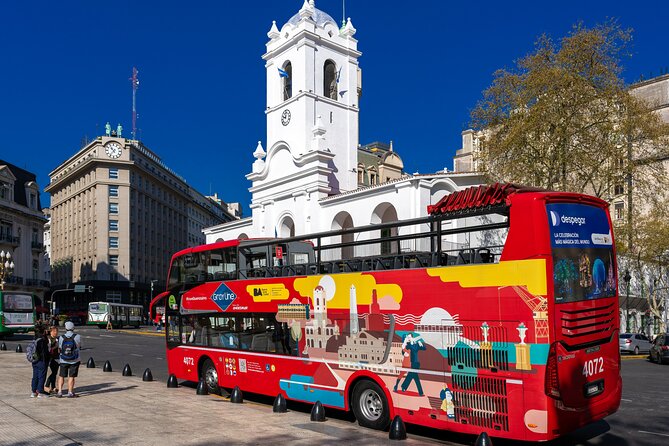
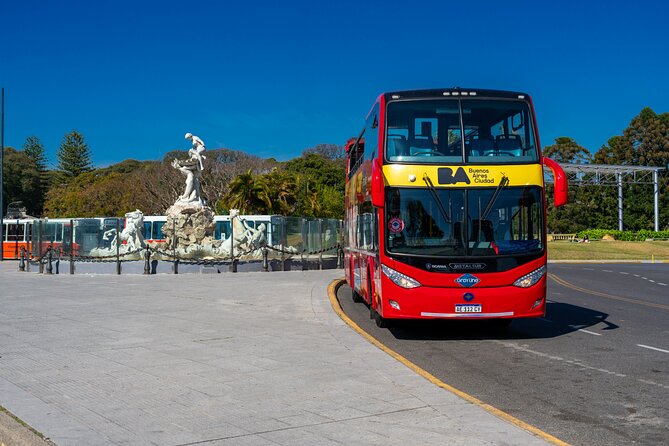
The buses are open-top double-deckers with air conditioning and a sunroof. The upper deck gives you the best sightlines, but sun, heat, rain, and wind can change the experience quickly. The covered air-conditioned section near the front provides a useful backup, especially in hot weather.
The multilingual audio guide is included, but do not expect a polished live guide speaking continuously. Some rides have had unclear sound, audio that cuts out, or commentary that does not line up with the actual location. Stop numbers have also occasionally been announced incorrectly.
Bring your own sense of direction. The route map, city map, and the view from the bus are often more useful together than the audio alone. If you want detailed local explanation, ask about a walking tour at the stop rather than relying only on the recorded commentary.
The supplied earphones have not suited everyone, and some people find them uncomfortable or too large. You may want to bring your own wired headphones if the bus system accepts them, but the information provided does not confirm a personal-device audio option.
Finding The Stops And Handling Route Changes
This is the biggest practical weakness. Some stops are well marked, but others have little or no visible sign. Exact pickup points can be difficult to locate, especially when you are looking at an address that covers a long stretch of pavement.
The printed map and the bus announcement may not always agree. Some stop numbers have been off by one, and route changes have occurred without clear advance notice. That does not ruin the ride, but it can cause you to miss a stop you planned to visit.
I would arrive at the stop early, stand where the map places it, and ask nearby staff or the bus host for confirmation. Keep the stop name, not just the number, in mind. If the route changes, a named location such as Recoleta or Puerto Madero is easier to communicate than a number.
The service is near public transportation, so you have a backup if you miss a bus or decide the wait is too long. Still, the bus is not ideal for a tightly scheduled itinerary. Some waits have lasted 40 minutes, and one missed or canceled section can affect the rest of your day.
Who Gets The Most Value From The $39 Price
The $39 starting price makes the most sense when you value convenience and broad coverage. You are paying for access to far-flung areas, not just a narrated ride around the center.
I would recommend it for:
- A first visit when you want to compare several districts quickly.
- A short stay when taxis or repeated metro journeys would take planning time.
- Families or mixed-age groups who need an easy way to cover long distances.
- Anyone interested in La Boca, Recoleta, Puerto Madero, Palermo, and Núñez in one pass.
- Visitors who enjoy choosing stops as they go rather than following a fixed tour.
I would be more cautious if you prefer detailed guiding, exact departure times, or a fully marked route. Buenos Aires has useful public transport, and independent walking combined with the metro may offer better value if you already know where you want to go.
The voucher book can improve the price if you use its selected discounts, but the actual savings depend on the businesses and benefits included with your chosen option. Treat it as a possible bonus, not the main reason to book.
Booking, Pass Length, And Walking Tours
You can choose a 1, 2, or 3-day pass. The pass period begins when you activate the ticket, and a 24-hour period may stretch across two calendar days if you start later in the day.
That makes timing important. If you arrive in the afternoon, activating a 1-day pass then may give you useful service into the next day, depending on the operating period. Confirm the exact terms for your chosen option before you board.
The optional walking tours require you to reach the correct stop and reconfirm the schedule with the guide onboard. They operate under weather and operating conditions, and no refund is given if you decide not to take one or it does not operate.
You receive confirmation at booking. Service animals are allowed, and most people can participate. Hotel pickup and drop-off are not included, and food and drinks are your responsibility.
Free cancellation is available if you cancel at least 24 hours before the local start time. If you need to change the pass duration after booking, cancel the original reservation and make a new one, because the QR code is issued automatically and may not update correctly after a direct modification.
Should You Book The Buenos Aires Bus?
Book it if you want a broad first look at Buenos Aires, value an open-top ride, and can stay flexible when stops or traffic cause delays. The route covers enough ground to make the city feel understandable, and the hop-on system lets you turn that overview into your own day.
Skip it if you need precise transport, strong live narration, or clearly marked stops at every attraction. In that case, use the metro and walking for the areas you already care about.
My practical choice would be the 1-day pass for a first orientation, unless you plan to spend real time at La Boca, Recoleta, MALBA, Puerto Madero, and the northern districts. Ride the whole loop early, note the stops you want, and then hop off with a plan rather than treating the bus as a perfectly timed city shuttle.
FAQ
How long does the full Buenos Aires bus route take?
The complete loop takes approximately three hours, although traffic can make the ride longer.
Can I choose how long my bus pass lasts?
Yes. The available options are 1-day, 2-day, and 3-day passes. The pass begins when you activate it.
Are walking tours included?
Optional walking tours are included as an activity, but they use a voluntary payment system for the guide. You must confirm the schedule with the guide onboard and reach the correct stop.
Does the bus include hotel pickup and food?
No. Hotel pickup and drop-off, food, and beverages are not included.
Are the buses air-conditioned?
The open-top double-decker buses have air conditioning and a sunroof. The upper deck may still feel hot or exposed depending on the weather.
What happens if I want to change the duration of my ticket?
You should cancel the existing reservation and create a new one. The QR code is automatically issued with each reservation and may not update if you modify the original booking.
Just joined the route map around the world
- San Pedro de Atacama: Vallecito + Magic Bus★ 5.0 · 4 reviews
- Santander: City Sightseeing Hop-On Hop-Off Bus Tour & Train★ 4.3 · 170 reviews
- Santiago: 1-Day Hop-On Hop-Off Bus and Cable Car Ticket★ 4.3 · 332 reviews
- San Francisco: Sightseeing Sunset Tour by Open-Top Bus★ 4.4 · 105 reviews
- San Francisco: Movie Filming Locations Bus Tour★ 4.9 · 368 reviews
- San Fransisco: Vintage VW Bus Wine Country Tour Small Group★ 5.0 · 5 reviews
- SF: Napa & Sonoma Wine Tour & Hop-on Hop-off Tour (Save 15%)★ 4.5 · 2 reviews
- San Francisco: Hop-On Hop-Off Tour with Optional Night Tour★ 4.5 · 94 reviews