

Review · OSAKA
7 Day Bus Pass: Tokyo, Kanazawa, Takayama, Kyoto and More
A seven-day LIMON Pass gives you a practical way to cross Japan’s Golden Route without rebuilding your transport plan at every station. You can connect Tokyo, Takayama, Kanazawa, Kyoto, and Osaka, with direct service to places that are not always easy to reach by train. Select departures also add Mt. Fuji 5th Station or Shirakawago.
I like the freedom to shape your own route, and I like the daily departures that make the pass useful for a multi-city trip. The main catch is that this is not a hop-on bus where you simply appear at the station. You must reserve a seat for every leg after buying the pass, and all people on one booking must travel together.
Key points to know before booking
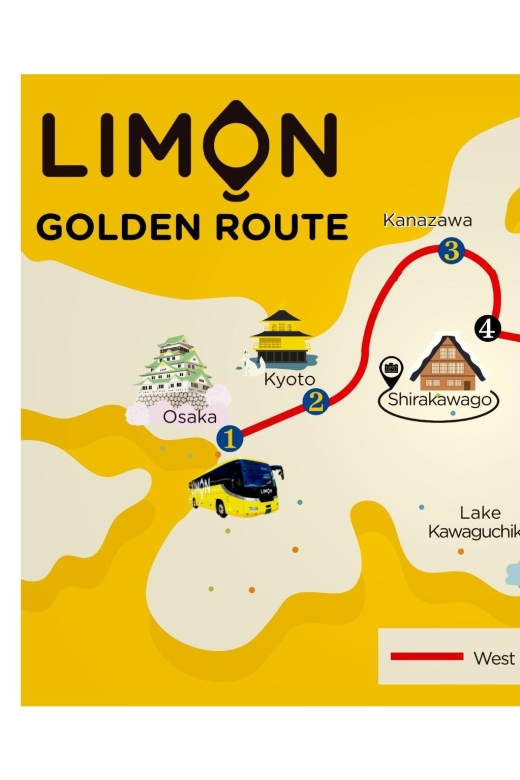
- Seven days across central Japan: Use the pass along a route linking Tokyo or Osaka and Kyoto with several major sightseeing stops.
- Direct access beyond the rail network: Reach Takayama, Kanazawa, Hirayu Onsen, Kawaguchiko, and Shirakawago by bus.
- Sightseeing depends on the departure: Mt. Fuji 5th Station and Shirakawago are included only on select departures.
- Daily service keeps planning simple: LIMON offers guaranteed daily departures, though you still need a reserved seat.
- Taxi help fills awkward connections: A taxi can be arranged for Tokyo to Kawaguchiko or Tokyo to Takayama connections, including the ride from Highland Resort Hotel and Spa to Kawaguchiko Station.
- Baggage rules are firm: You can bring up to three pieces, with limits on size and what fits beside your seat.
How the seven-day LIMON Pass works
The pass costs $242 per person and is designed for a journey across several cities, not for one short transfer. Its listed activity duration is one day, but the transport pass itself is valid for seven days. Think of the one-day listing as the booking format for the pass rather than the length of your whole route.
You choose a starting direction: depart from Tokyo, or begin from Osaka or Kyoto. After purchasing, you use your GetYourGuide booking reference ID to reserve a seat for each stop on your planned trip. Your completed itinerary goes to the lead traveler’s email address.
That second step matters. You should not buy the pass and assume you can board any bus at any time. Reserve each segment in advance, then check your email carefully for the confirmed itinerary. You can change your reservation or departure point until noon on the day before departure.
This setup gives you freedom, but it also places some work in your hands. You decide how many nights to spend in each city, then match your plans to the available buses. If your schedule changes, the change deadline is clear, but it is not last-minute flexibility.
The buses are the heart of the experience. One verified booking described the drivers as excellent and the buses as clean and comfortable. That is especially important on long Japanese road journeys, where a tidy vehicle and a reliable driver make a real difference.
More seats worth taking around Japan:
- Mt Fuji and Hakone 1-Day Bus Tour Return by Bullet Train
★ 5.0 · 26,383 reviews - 1-Day Tokyo Bus Tour
★ 5.0 · 14,250 reviews - PERFECT KYOTO 1-Day Bus Tour
★ 5.0 · 13,518 reviews
Tokyo to Kawaguchiko and the Mt. Fuji connection
Tokyo is one of the two main starting points. From there, the route can take you toward Lake Kawaguchiko, a strong choice if you want a Fuji-area stop before continuing west.
Kawaguchiko is the practical base for seeing Mt. Fuji, though the pass information does not promise a specific view. Weather controls Fuji viewing, so keep your expectations sensible. The useful point here is access: the bus links the Tokyo portion of your trip with a major Fuji sightseeing area without asking you to arrange every transfer yourself.
Some departures include sightseeing at Mt. Fuji 5th Station. This is not an automatic feature of every journey, so check the departure details before booking. If the 5th Station matters to you, build your route around a departure that specifically includes it.
The Tokyo to Kawaguchiko connection can involve a taxi arrangement. LIMON says it can arrange a taxi for customers traveling between Tokyo and Kawaguchiko. That may help when the regular bus connection does not leave you at the most convenient point.
You should still pay close attention to the exact meeting point. It varies by the option you book. The stated coordinates, 34.66652297973633, 135.49514770507812, point to the Osaka area rather than serving as a universal location for every departure. Your itinerary email is the document to follow.
Hirayu Onsen and Takayama
The route then reaches the mountain town of Takayama, with Hirayu Onsen included as a stop along the way. This is where the pass becomes more useful than a simple Tokyo to Kyoto transfer.
Takayama gives you a different side of Honshu from the huge cities. Its appeal is tied to its traditional town setting and access to the surrounding mountain region, while Hirayu Onsen offers a natural pause on the route. The information provided does not include a guided visit or admission to a bath, so treat Hirayu Onsen as a transport stop unless your confirmed itinerary says otherwise.
The route between Tokyo and Takayama may include taxi support. LIMON specifically describes a taxi from Highland Resort Hotel and Spa to Kawaguchiko Station for this connection. That is a useful detail to check before you travel, because a bus route with a taxi link is not the same as a single through-bus journey.
Takayama is best suited to you if you want more than Japan’s major urban centers. The tradeoff is time. A cross-country itinerary with Tokyo, Fuji, Takayama, Kanazawa, Kyoto, and Osaka can become rushed if you try to give every stop equal weight. The pass gives you transport freedom, but it cannot create extra nights.
Shirakawago on selected departures
Shirakawago is one of the most appealing special features in the route, but it comes with an important condition: sightseeing there is offered only on select departures.
That means you should not treat Shirakawago as a guaranteed stop simply because it appears in the overall route description. Check the specific departure before you commit to hotels and onward connections. If the village is a main reason for buying the pass, make it the anchor of your plan rather than hoping it will fit later.
A departure that includes Shirakawago can save you the trouble of arranging a separate day trip from another city. It also lets you connect the village with Takayama or Kanazawa, rather than returning to the same base. The value is greatest when you want a one-way route through the mountain region.
The pass does not include meals or accommodation. Plan those separately, especially around rural stops where your choice of lodging may be more limited than in Tokyo, Kyoto, or Osaka.
More bus tours around Japan:
- Peaceful Hiroshima & Miyajima UNESCO 1 Day Bus Tour
★ 5.0 · 5,309 reviews - Kyoto: Fushimi Inari, Kinkakuji, Bamboo Grove 1 Day Bus Tour
★ 4.8 · 4,316 reviews - Tokyo: Meiji Shrine, Asakusa, Skytree Bus Tour and Cruise
★ 4.7 · 1,986 reviews - Tokyo: Kamakura & Enoshima Day Trip including Temple Tickets
★ 4.5 · 1,375 reviews
Kanazawa, Kyoto, and Osaka
Kanazawa gives the route another worthwhile change of pace before you reach the Kansai cities. It is a direct stop on the LIMON network, making it possible to include Kanazawa without treating it as a separate side trip.
The supplied information does not promise a guided tour of Kanazawa, entrance tickets, or local sightseeing. You are buying transport, not a city tour. That is good news if you prefer to set your own pace, but you need to plan your own time in town.
From Kanazawa, the route continues toward Kyoto or Osaka. You can use Kyoto as your final destination, Osaka as your final destination, or include both if your seven-day schedule permits. The pass is most useful when you have several legs to cover and do not want to purchase each bus journey separately.
Kyoto and Osaka are not interchangeable stops. Kyoto is the better fit if your plan centers on temples, traditional neighborhoods, and a slower sightseeing rhythm. Osaka makes sense if your trip ends there or if its location fits your onward travel. The pass lets you choose, but it does not tell you how long to stay.
What $242 buys you in practical terms
At $242 per person, the pass is a serious transport purchase. Its value depends on how much of the network you use.
I would consider it a good fit if you plan to link several of these points:
- Tokyo
- Lake Kawaguchiko
- Hirayu Onsen
- Takayama
- Kanazawa
- Kyoto
- Osaka
It becomes less convincing if you only need one or two bus journeys. In that case, a single-ticket comparison may be worthwhile. The supplied information does not give individual fares, so I cannot promise that the pass saves money in every combination.
The pass offers value beyond the raw fare. It gives you one transport framework, daily service, seat reservations, and access to routes that can be awkward to organize alone. For a first visit to Japan, that can remove a lot of uncertainty.
Still, the pass does not cover everything. Meals, hotels, and your local sightseeing costs are separate. You also manage your own luggage, and the bus company does not accept responsibility for items that are lost, damaged, or left behind when negligence is not recognized.
Baggage limits and comfort on the road
The baggage policy deserves more attention than it usually gets. You may bring a maximum of three pieces:
- One large suitcase with total dimensions no greater than 208 centimeters
- One small suitcase with total dimensions no greater than 126 centimeters
- One small carry-on bag that fits with you at your seat
These limits are not a suggestion to pack heavily. A large case, a small case, and a carry-on can add up quickly when you are moving through several cities. Pack so you can handle your own bags during transfers and at meeting points.
Baggage storage is available, but the supplied information does not explain where it is offered, how long storage lasts, or whether every departure includes it. Confirm the details for your chosen route instead of assuming storage will solve every luggage problem.
The vehicle may vary depending on passenger numbers. That means the exact bus type is not fixed. The strongest practical information available is that the buses are clean and comfortable, with excellent drivers praised in a verified booking. You should still bring comfortable clothes, as recommended, and keep cash with you.
Smoking and pets are not allowed. Meals are not included, so carry money for food during the journey and at stops.
Reservations, timing, and the booking routine
The best way to use this pass is to sketch your route before you buy it. Decide your direction, identify the cities you want, and check which departures include Mt. Fuji 5th Station or Shirakawago.
Then reserve the seats promptly after purchase. The booking system uses your GetYourGuide reference ID, and the itinerary is sent to the lead traveler. Keep that email accessible on your phone, and make sure everyone in the booking follows the same itinerary.
All members under one booking must travel together. This is fine for a couple or family with a shared plan, but it does not suit a group that wants to split up for different departures.
You can alter the reservation or departure point until 12 PM the day before travel. That gives you some breathing room, but not enough to treat the pass as completely spontaneous. A missed bus or late change could affect several later reservations.
Cancellation is generous only if handled early: you can cancel up to 11 days in advance for a 95 percent refund. After that point, the provided information does not promise the same refund.
Who will get the most from this pass
I would point this pass toward an independent visitor who wants to see several parts of Honshu but does not want to arrange every long-distance bus separately. It suits a person who enjoys choosing their own hotels and sightseeing plans while keeping the main transport structure in one place.
It is also a good match if Takayama, Kanazawa, Kawaguchiko, or Shirakawago matters to you. These stops give the route more character than a simple Tokyo to Kyoto journey.
I would be more cautious if you want a fully guided tour. There is no guide name provided, and the experience is described as transportation with selected sightseeing stops, not a guided cultural program. You are responsible for your own meals, lodging, baggage, and local activities.
I would also think twice if you dislike fixed departure times. Daily service helps, but each segment still needs a reservation. The pass gives you a framework, not unlimited freedom.
Should you book the LIMON Pass?
Book it if you want a multi-city Honshu route and plan to use several included stops within seven days. The direct links, daily departures, taxi support on select connections, and access to Takayama, Kanazawa, and Shirakawago make it more useful than a basic Tokyo to Osaka transfer.
Before paying $242, confirm three things: your chosen direction, the availability of your preferred departure dates, and whether Mt. Fuji 5th Station or Shirakawago is included on the specific bus you want. If those details match your plan, the pass can make a complicated route much easier to manage.
Skip it if you need only one or two transfers, want a guided tour, or prefer to decide every move at the last minute. For the right itinerary, though, this is a sensible road-based way to connect Japan’s famous cities with its mountain towns.
FAQ
How long is the LIMON Pass valid?
The pass allows travel along the route for seven days. The activity is listed as having one-day validity for booking purposes, so check the date and route details you receive after purchase.
Which cities and stops are included?
The listed stops are Tokyo, Lake Kawaguchiko, Hirayu Onsen, Takayama, Kanazawa, Kyoto, and Osaka.
Are Mt. Fuji 5th Station and Shirakawago included on every departure?
No. Sightseeing at Mt. Fuji 5th Station and Shirakawago is available on select departures only.
Can I start the route in Tokyo?
Yes. You can choose a route departing from Tokyo.
Can I start the route from Kyoto or Osaka?
Yes. The pass also offers routes departing from Osaka or Kyoto.
Do I need to reserve seats after purchasing?
Yes. After purchase, use your GetYourGuide booking reference ID to reserve a seat for each stop on your trip.
Can people on the same booking travel separately?
No. All members under one booking must travel together.
How much luggage can I bring?
You can bring up to three pieces: one large suitcase up to 208 centimeters in total dimensions, one small suitcase up to 126 centimeters, and one small carry-on bag for your seat.
Are meals and accommodation included?
No. You must arrange and pay for meals and accommodation yourself.
Can I change my departure point?
You can modify your reservation or departure point until 12 PM on the day before departure.
Just joined the route map around Japan
- Osaka/Kyoto: Katsuoji, Kinkakuji, Arashiyama 1-Day Bus Tour★ 4.6 · 33 reviews
- Okinawa: Full-Day Bus Tour to Yanbaru National Park★ 4.3 · 44 reviews
- Okinawa: Tropical Dream , Ryukyu Mura, Banta Cafe Bus Tour★ 4.3 · 19 reviews
- Okinawa: Churaumi Aquarium, Ryukyu Village & Manza Bus Tour★ 4.5 · 118 reviews
- Okinawa: Double-Decker Open Top Bus Tour for Shuri Castle★ 4.0 · 3 reviews
- Okinawa Churaumi or Tropical, Kouri American Village BusTour★ 4.4 · 140 reviews
- Okinawa: Bus Tour to Churaumi Aquarium with Sightseeing★ 4.3 · 20 reviews
- Kyoto: Full-Day Guided Bus Tour to Top Highlights & Tickets★ 4.6 · 533 reviews
Osaka Bus Tours, side by side.
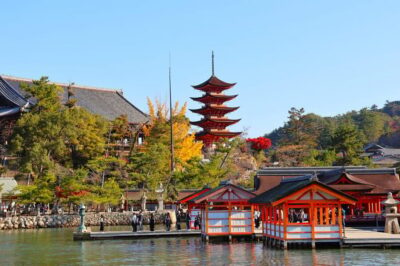
Osaka/Kyoto: Hiroshima Miyajima Bus Tour & Shinkansen Ticket
Read our review →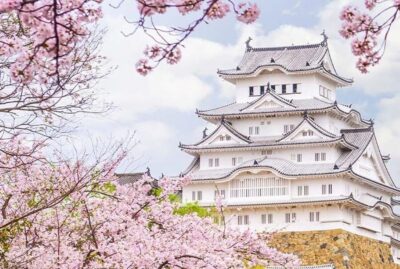
From Osaka: Himeji Castle, Arima Onsen & Mt. Rokko Day Tour
Read our review →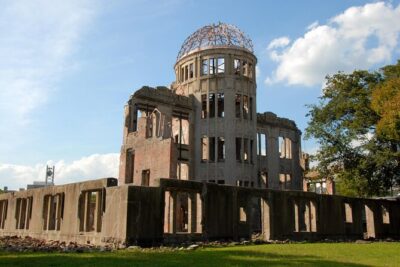
Hiroshima & Miyajima 1 Day Bus Tour with Bullet Train Tickets
Read our review →
Play with Snow Crab Buffet Lunch and Strawberry Picking Bus Tour
Read our review →Other lists with this bus tour