
Review · BUS TOURS
Buenos Aires: Hop-On Hop-Off City Bus Tour
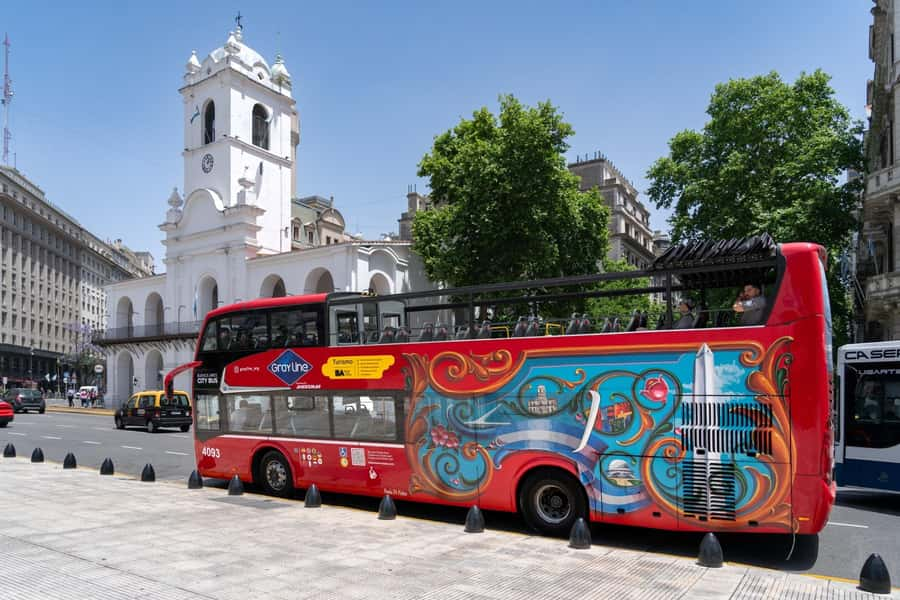
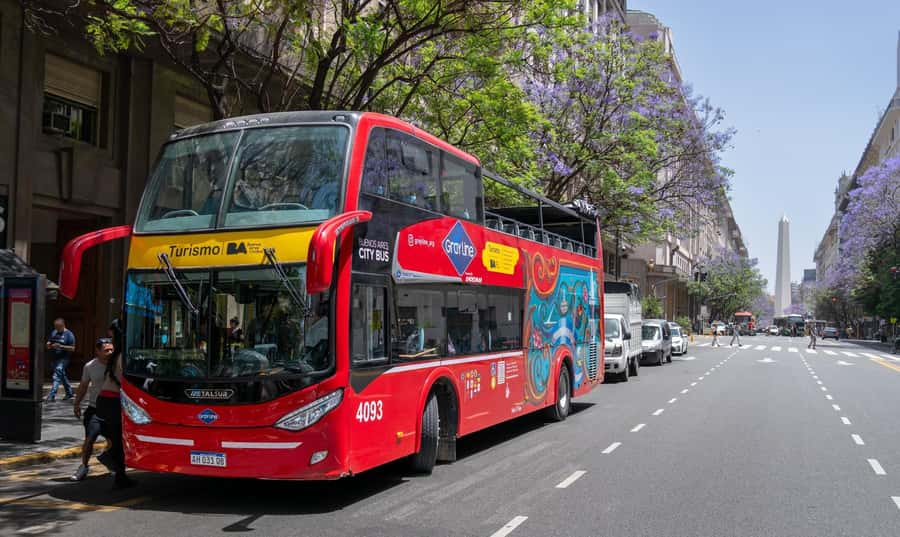
Buenos Aires is too spread out to understand on foot in one day, and this open-top bus route gives you a useful first look at its very different barrios. In one long circuit, you pass colorful La Boca, polished Puerto Madero, leafy Palermo, Recoleta, Chinatown, and the River Plate and Boca Juniors stadiums.
I like the frequent 25-minute service and the choice of staying aboard for a full city survey or hopping off at places that catch your eye. I also like the clear multilingual commentary, which includes Spanish, English, Portuguese, Japanese, Chinese, Russian, Italian, French, German, Ukrainian, and Korean. The main drawback is time: a complete loop can take about three hours, and traffic can make the wait longer than 25 minutes.
Key points to know before you board
- A three-hour city overview: Stay on for the full circuit and cover a wide slice of Buenos Aires without arranging several separate rides.
- La Boca is the essential stop: Get off near Caminito and La Bombonera for the city’s most colorful streets and famous football culture.
- Two useful starting points: Begin at Diagonal Norte, Av. Pres. Roque Sáenz Peña 728, or the office at Plaza San Martín, Av. Santa Fe 808.
- The ticket works as transport and sightseeing: Use it for a ride between neighborhoods, not just a narrated loop.
- The 48-hour ticket offers the best balance: It gives you time to split the long route over two days and make several stops.
- Bring a light layer and patience: The upper deck has excellent views, but it can feel cool, and traffic sometimes affects the schedule.
Why this bus helps you understand Buenos Aires
Buenos Aires is a city of contrasts. Grand civic buildings sit near old working-class districts. Waterfront apartments give way to football grounds, parks, museums, and residential neighborhoods. A taxi can carry you from one sight to another, but you may miss the way the city changes between them.
The bus gives you that connecting view. You see how the center leads toward San Telmo and La Boca, how Puerto Madero differs from the older quarters, and how the northern districts become greener and more residential. I find that especially useful on a first visit, when a city map still feels like a collection of names.
You can ride the entire circuit from the upper deck, listen to the audio guide, and use the first day to decide where you want to return. If your time is short, this is still worthwhile. A flight delay left one passenger with time only for the full loop, which took more than three hours but still provided a strong sense of the city.
The route is not a small neighborhood shuttle. It covers a large area, so plan around that fact. If you get off for lunch or a museum, you may spend a good part of the afternoon waiting for the next bus and then completing another section of the route.
More Hop-On Hop-Off Bus Tours in the world:
- Barcelona: 24 or 48-Hour Hop-On Hop-Off Bus Tour
★ 4.4 · 20,872 reviews - Rome: City Sightseeing Hop-on Hop-off Bus with Audioguide
★ 4.0 · 16,045 reviews - Paris: Tootbus Hop-on Hop-off (Optional River Cruise)
★ 4.3 · 15,279 reviews
The center, Congress, and San Telmo
The two principal starting points make the service easy to fit into a central Buenos Aires day. Stop 0 is on Diagonal Norte at Av. Pres. Roque Sáenz Peña 728. The other starting point is the Plaza San Martín office at Av. Santa Fe 808.
From the center, the bus passes the Palace of the Argentine National Congress. You do not get an included entry here, but the passing view helps place the city’s government district within the wider route. The audio guide provides context as you move through the central streets.
The route then reaches the El Loco Chávez stop and the Paseo de la Historieta. This is a lighter, more playful part of the circuit, tied to Argentine comic characters and public art. It makes a good contrast with the formal buildings near Congress.
Plaza Dorrego is another important San Telmo reference point. The square is connected with one of Buenos Aires’ oldest-feeling districts, where narrow streets and older buildings replace the broad avenues of the center. The bus only passes the stop, so get off if you want time in the neighborhood.
San Telmo is best treated as a walking stop rather than something to view through a window. You can leave the bus, wander, and later continue the route. With a 24-hour ticket, avoid trying to combine too many stops in one afternoon. The long circuit can make a short stop feel surprisingly expensive in time.
Usina del Arte, La Bombonera, and Caminito
The southern section becomes more distinctive as the route reaches Usina del Arte, a cultural space housed in a former power station. It is one of the more unusual buildings along the circuit, and the stop gives you a reason to see a part of the city that can be missed on a standard central walking tour.
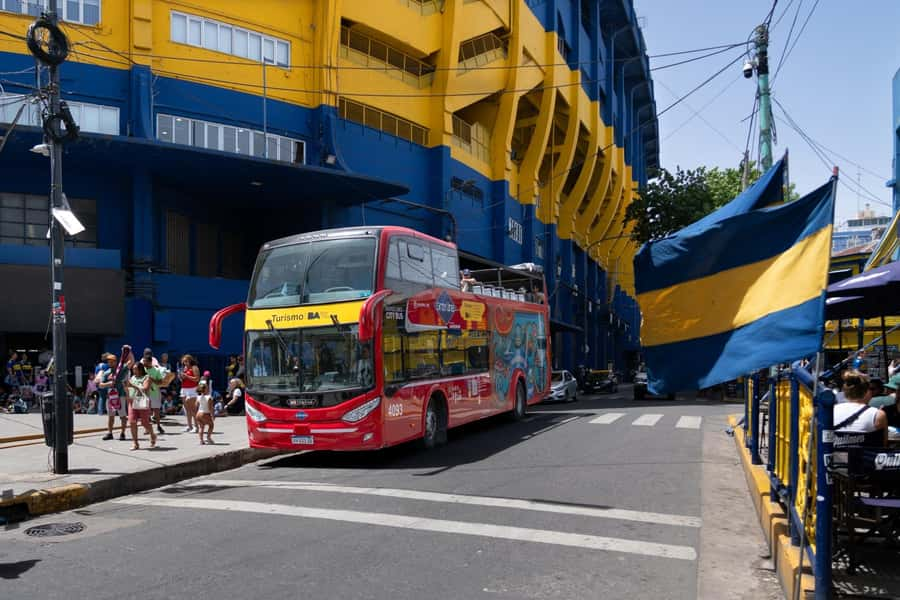
Next comes La Bombonera, home of Boca Juniors. Football is not a side note in Buenos Aires. It is part of the city’s identity, and seeing the stadium helps explain the passion attached to the Boca neighborhood.
The nearby Caminito area is the stop I would prioritize. Its painted buildings and busy street scene are among the most recognizable sights in Buenos Aires. You can get off, walk around, and take in the colorful facades at street level instead of settling for a quick view from the bus.
The bus also provides access to the Boca Museum from the Bombonera stop. Admission is not included, so check the time and cost before committing to the stop. On days when Boca Juniors plays at the stadium, tours do not take place, so a match-day visit needs extra care when you plan your schedule.
Caminito is also where the hop-on hop-off format proves its worth. A regular city bus might get you close, but this service gives you a narrated route and a clear place to continue afterward. I would allow enough time here to walk, then board with the expectation that the next bus may not arrive at exactly 25 minutes.
Puerto Madero and the riverfront
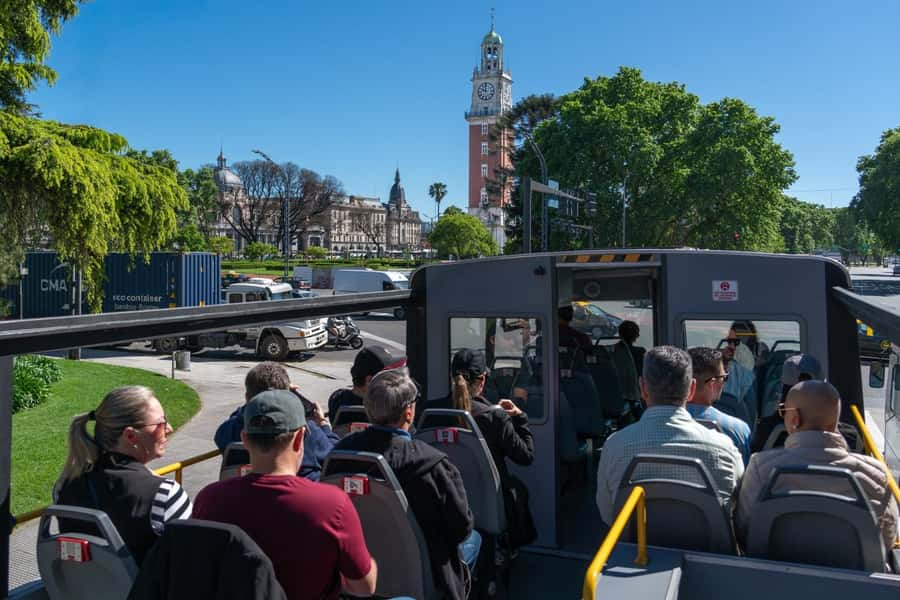
After the southern neighborhoods, the route moves toward Costanera Sur and Puerto Madero. The change is striking. Older streets and colorful facades give way to modern development, wide open spaces, and a more polished waterfront setting.
Puerto Madero is a useful stop for a meal or a separate walk. It also breaks up the long circuit nicely. If you are riding in hot weather, remember that the open upper deck offers shade only in some places, while the lower deck has air conditioning.
The route includes the tourist circuit’s Estación Fluvial stop. This connects with the riverfront and other activities, although those activities are not included in the bus ticket. The value here is flexibility: you can use the bus to reach the area without paying for a separate ride across the city.
The onboard WiFi and WiFi at bus stops are included. In practice, do not rely on it as your only map connection. It has worked unevenly, and the real-time map can be hard to find or less useful than expected. Downloading your essential directions before setting out is sensible.
More bus tours around the world:
- Mt Fuji and Hakone 1-Day Bus Tour Return by Bullet Train
★ 5.0 · 26,383 reviews - London: Warner Bros. Studio Harry Potter Tour & Branded Bus
★ 4.7 · 19,194 reviews - Amsterdam: Zaanse Schans, Edam, Volendam & Marken Bus Tour
★ 4.6 · 15,034 reviews - 1-Day Tokyo Bus Tour
★ 5.0 · 14,250 reviews
Retiro and the northern museums
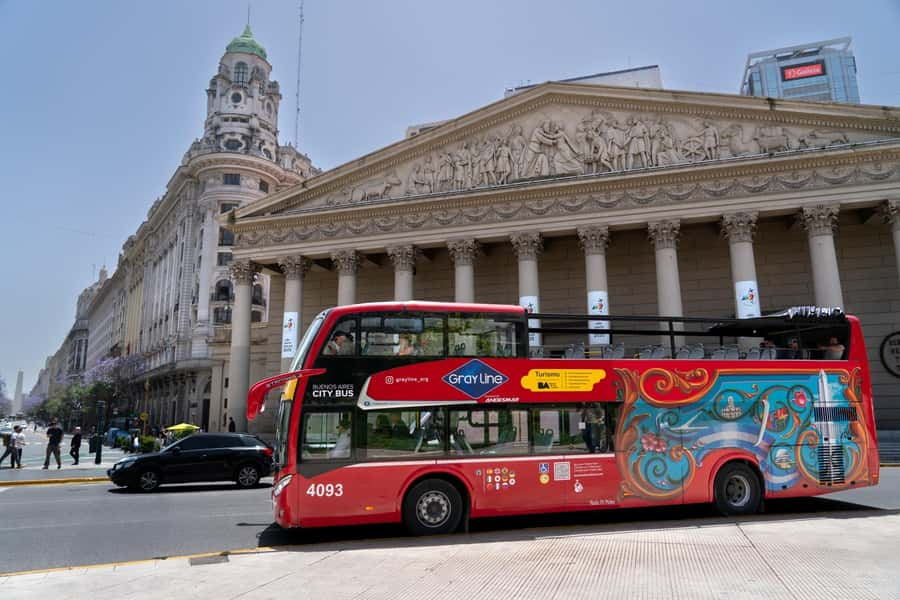
The circuit returns north through Galerías Pacífico and Plaza General San Martín. Galerías Pacífico is a major shopping center in a central location, while Plaza San Martín provides a calmer green space near the bus office and the Retiro area.
From here, you reach Floralis Genérica, the large metal flower sculpture that has become one of the city’s modern icons. The bus offers a quick way to connect it with the next group of stops, though you may need to walk from the bus stop for the best view.
The Museo de Arte Latinoamericano de Buenos Aires, known as MALBA, is one of the strongest cultural stops on the route. It focuses on Latin American art, and the bus makes it easier to combine with neighborhoods farther south or north. Museum admission is separate.
The Planetario Galileo Galilei follows in the Palermo area. Its distinctive building and surrounding parkland give the ride a change of pace after the denser central districts. You can stay aboard for the view or get off if you want a closer look.
The Club de Pescadores and Jorge Newbery Airfield show a different side of the city, with the route following the broad northern riverfront. These are not the headline stops for most first-time visitors, but they help you see how much of Buenos Aires stretches beyond its historic center.
Parque de la Memoria, River Plate, and Chinatown
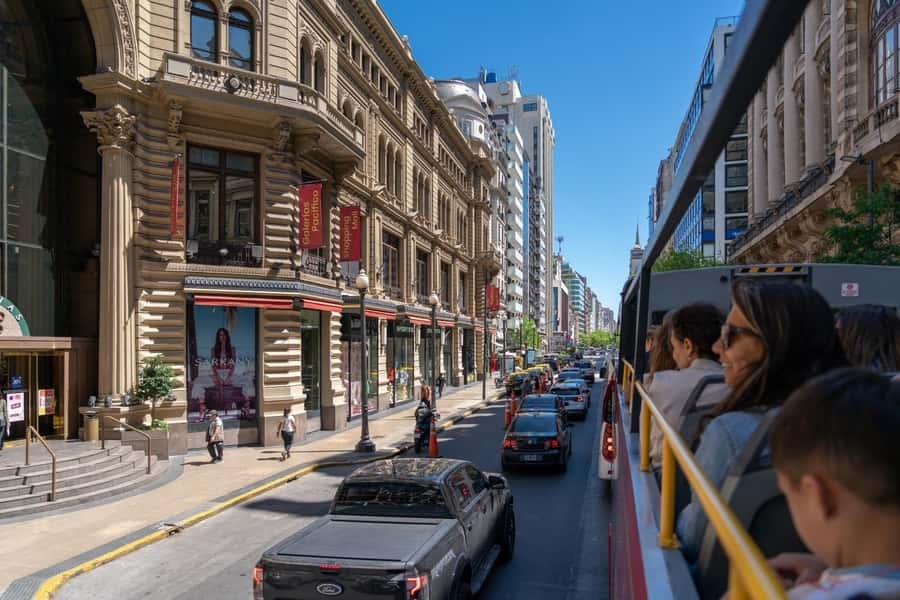
Parque de la Memoria is an important memorial space. It adds serious historical context to the trip and gives the route more substance than a simple parade of monuments and shopping streets. If you get off, give yourself time to absorb the setting rather than treating it as a quick photograph.
The bus then reaches Estadio Monumental Antonio Vespucio Liberti, home of River Plate. You can access the River Museum from this stop, with admission paid separately. Football fans should plan this section carefully because stadium match days stop the tour from operating.
The River Plate and Boca Juniors stops are a major strength of this route. Many city sightseeing buses focus only on monuments, while this one connects two places that help explain modern Argentine life. You do not need to be a serious football fan to find the contrast useful.
Chinatown comes next, offering another shift in the city’s character. It is a good place to break up the sightseeing with food or a short walk. The northern part of the route feels less like a checklist of major monuments and more like a look at how Buenos Aires is lived in from neighborhood to neighborhood.
The Argentine Polo Association and the Carta Magna Monument continue through the northern districts. These stops may be less essential if you have only one day, but they make the full circuit worthwhile for anyone who wants a broad view rather than only the central sights.
Recoleta and Teatro Colón
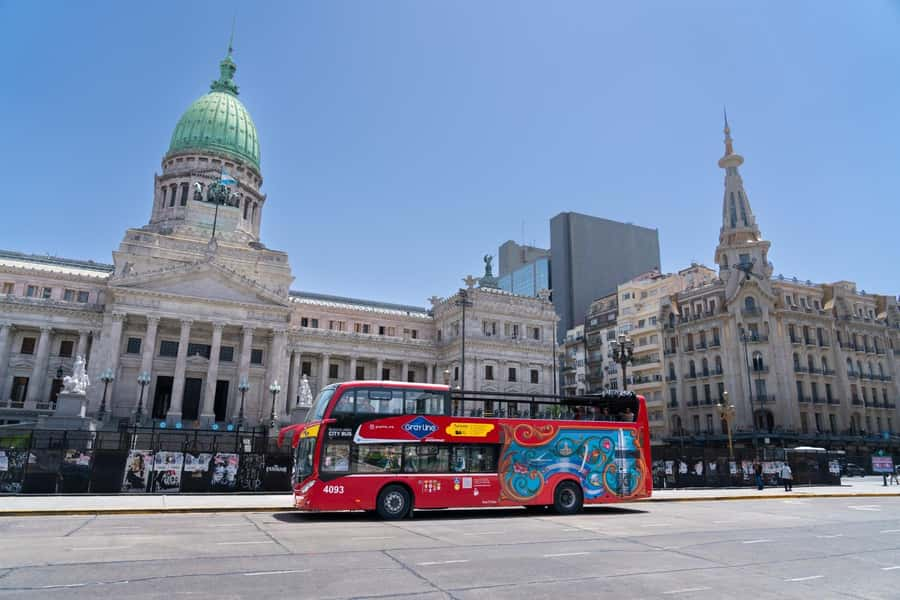
Recoleta is one of the most important stops on the northern half of the route. The district is known for elegant streets and major cultural sights, though the red route does not stop directly at the famous Buenos Aires Cemetery. A separate yellow bus route has a stop there, while the nearest red-route stop is about a mile away.
That detail matters. If the cemetery is your main goal, check the route you are boarding before you set off. The red route still gets you into the general Recoleta area, but it may not deliver you to the entrance in the convenient way you expect.
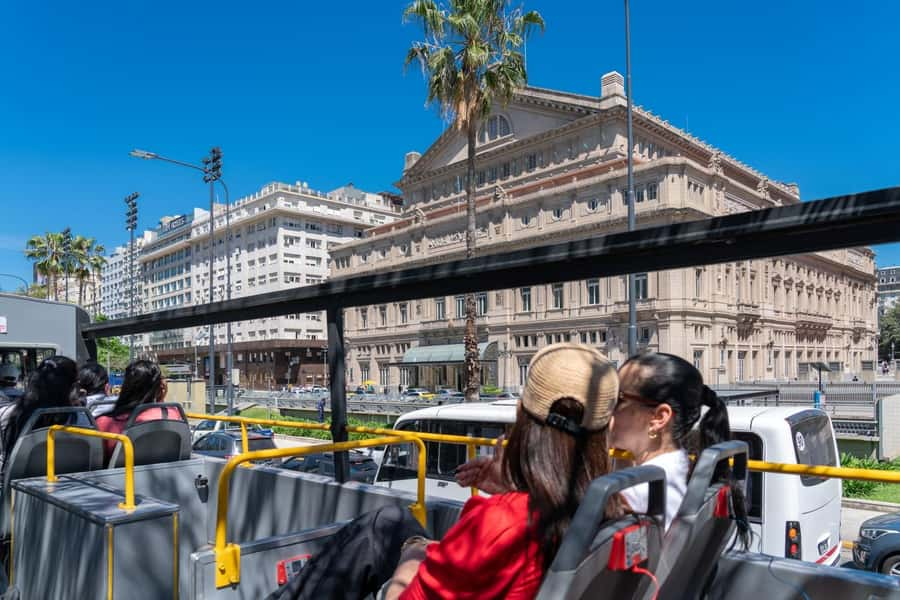
The final major sight is Teatro Colón, one of Buenos Aires’ best-known cultural buildings. The bus passes it rather than including a performance or guided interior visit. If you want to see inside, plan that separately and do not assume the bus ticket covers entry.
The full loop ends back at the starting point. You do not need to finish where you began, since you can board and leave at any listed stop, but returning to the center makes the service easy to use as a complete sightseeing ride.
How long the loop really takes
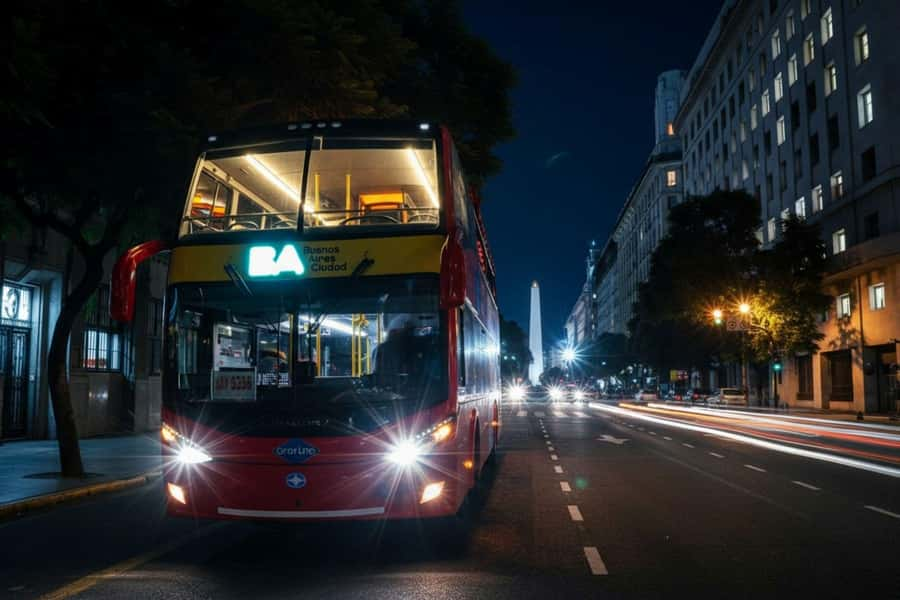
The advertised bus frequency is about 25 minutes during the day, with service operating from Monday through Sunday. Buses begin circulating at about 9:20 a.m. from Stop 0 and Stop 12, and regular operating hours are listed as 9:30 a.m. to 6:00 p.m.
The last buses leave at about 5:30 p.m. and make only half a return along the route. Do not board a late afternoon bus expecting a full city circuit.
A complete red-route loop takes roughly three hours. Traffic, boarding delays, and crowds can stretch that time. One ride waited about 35 minutes, and commentary sometimes described a sight just after the bus had passed it. Those are small problems if you are flexible, but frustrating if you have a timed museum admission.
For a first day, I would ride one complete section or the full loop without getting off. On a second day, choose two or three stops and give each one proper time. The 48-hour ticket is particularly useful because it lets you separate the long ride from the walking.
Audio, seating, and comfort
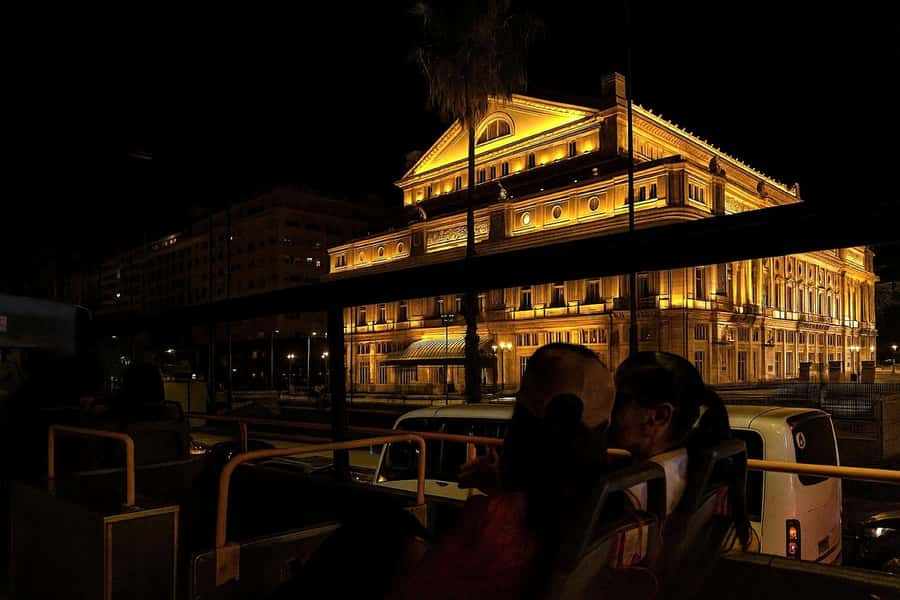
The audio guide is included and available in 11 languages. The commentary covers the sights and the city’s development, with local music playing between sections. English volume and clarity are generally strong, though timing can occasionally be off by a sight or two.
The buses are open-top double-deckers with air conditioning and a sunroof. The upper deck gives you the best view and a pleasant way to rest while still seeing the city. On hot days, it can be the most enjoyable place to ride, but the lower deck offers better shelter.
Some passengers have found the upper deck cool, and the earphone cords can be short when you are trying to use the headset at the upstairs seats. Staff are helpful, and the buses can be busy at certain times, though seats are not always difficult to find.
The service also includes a live guide in Spanish, English, and Portuguese. The audio and live announcements can occasionally overlap, which makes some information hard to hear. I would use the audio guide as the main source and treat the stop announcements as practical reminders.
Choosing 24, 48, or 72 hours
The price is listed at $35 per person. That is fair if you use the bus for several rides or visit stops spread across the city. It is less convincing if you stay aboard for one loop and do not use the ticket to reach any attractions.
A 24-hour ticket suits a short stay and a quick overview. It works best if you start early and choose only a few stops. Since the loop is long, trying to see La Boca, Puerto Madero, Palermo, Recoleta, and both stadiums in one day will leave you spending much of the day in transit.
The 48-hour option is the best fit for most people. Use the first day to learn the route and the second to return to La Boca, Recoleta, MALBA, Puerto Madero, or the stadium stops. The 72-hour option gives you the most freedom, especially if you want a slower pace.
Your ticket period begins the first time you board, not necessarily on the original booking date. A purchased ticket can be started within six months, according to the activity terms. The reservation date and time can also matter if your booking includes the separate brunch service at El Gato Negro, where missing the confirmed time means losing that non-refundable brunch.
Cancellation is free up to 24 hours before the activity, and you can reserve now and pay later. Those terms are useful when flight times or city plans are unsettled.
Is the Buenos Aires bus tour worth booking?
I would book this bus if you are visiting Buenos Aires for the first time, want to see several far-flung districts, or prefer an easy overview before choosing where to spend your walking time. It is also a good choice for families, older visitors, and anyone who wants a safe, simple way to cross a large city.
I would not choose it as your only plan if you want detailed time inside museums, a direct ride with no delays, or a tightly scheduled sightseeing day. The route is long, the bus can run late, and some attractions require a walk or separate admission.
For the best value, choose 48 hours, ride a full circuit early, and use the next day for La Boca, one northern stop, and either Puerto Madero or Recoleta. Sit upstairs when the weather is comfortable, keep a backup map on your phone, and leave room in your schedule for Buenos Aires traffic. Used that way, the bus does more than show you famous sights. It helps you understand how the city’s neighborhoods fit together.
FAQ
Where can I start the bus tour?
You can start at any bus stop. The two listed starting points are Stop 0 at Diagonal Norte, Av. Pres. Roque Sáenz Peña 728, and Stop 12 at Plaza San Martín, Av. Santa Fe 808.
How often do the buses run?
The buses are scheduled about every 25 minutes during the day. Traffic and boarding can cause delays, and one ride may take longer than the published interval.
What are the operating hours?
The service operates Monday through Sunday. Buses begin circulating at about 9:20 a.m., regular operating hours are listed from 9:30 a.m. to 6:00 p.m., and the final buses leave at about 5:30 p.m. for a half return.
How long does a full loop take?
A complete loop takes roughly three hours, although traffic and stops can make the ride longer.
Which languages are available for the audio guide?
The audio guide is available in Spanish, English, Portuguese, Japanese, Chinese, Russian, Italian, French, German, Ukrainian, and Korean. Live guides are listed for Spanish, English, and Portuguese.
Does the ticket include attraction admission?
No. The bus ticket, open-top bus ride, and multilingual audio guide are included, but admission to museums, stadium attractions, and other sights is separate. Food and drinks are also not included.
Can I visit the Boca and River Plate museums from the bus?
Yes. The Boca Museum can be accessed from the Bombonera stop, and the River Museum can be accessed from the Monumental stop. On days when Boca Juniors or River Plate plays at its stadium, no tours take place.
Just joined the route map around the world
- San Pedro de Atacama: Vallecito + Magic Bus★ 5.0 · 4 reviews
- Santander: City Sightseeing Hop-On Hop-Off Bus Tour & Train★ 4.3 · 170 reviews
- Santiago: 1-Day Hop-On Hop-Off Bus and Cable Car Ticket★ 4.3 · 332 reviews
- San Fransisco: Vintage VW Bus Wine Country Tour Small Group★ 5.0 · 5 reviews
- San Francisco: Sightseeing Sunset Tour by Open-Top Bus★ 4.4 · 105 reviews
- San Francisco: Movie Filming Locations Bus Tour★ 4.9 · 368 reviews
- SF: Napa & Sonoma Wine Tour & Hop-on Hop-off Tour (Save 15%)★ 4.5 · 2 reviews
- San Francisco: Hop-On Hop-Off Tour with Optional Night Tour★ 4.5 · 94 reviews